My, how times have changdd and how they also femain the same. Enjoy the video.

Showing posts with label Special Forces. Show all posts
Showing posts with label Special Forces. Show all posts
Tuesday, September 21, 2021


Tuesday, June 9, 2020
RIP CSM Pete Morakon - Distinguished Member of the Regiment

In Korea, he was assigned to the 187th Airborne Regimental Combat Team as an infantry squad leader and attained the rank of staff sergeant. Upon his return from Korea in September 1952, he was honorably discharged from the service and worked in his hometown for a year before returning to the Army in October 1953.
In March 1954, CSM Morakon was assigned to the 504th Airborne Infantry Regiment at Fort Bragg as a reconnaissance squad leader and attained the rank of sergeant. In October 1955, he returned to Korea and was assigned to the 32nd Infantry Regiment as an infantry platoon sergeant. Upon his return from Korea, he was assigned to numerous airborne units, including the 504th Airborne Infantry Regiment, the 503rd Airborne Infantry Battle Group and the 501st Airborne Infantry Battle Group, in which he attained the rank of sergeant first class.
In March 1963, CSM Morakon attended the Special Forces Operations and Intelligence Course before being assigned to the 5th Special Forces Group (Airborne). He went to Vietnam in March 1964 as a Special Forces detachment intelligence sergeant and returned as a team sergeant with Company C, 5th Special Forces Group (Airborne).
He was promoted to master sergeant in September 1965 and was subsequently assigned to 3rd Special Forces Group (Airborne) as a HALO team sergeant. In April 1968, he returned to the 5th Special Forces Group (Airborne) in Vietnam for a third combat tour.
In March 1970, he was promoted to sergeant major and served as company sergeant major with the 6th and 5th Special Forces Groups (airborne). In 1975, he was appointed to command sergeant major and assigned to the 71st Air Defense Artillery and later the 94th Air Defense Artillery Group in Germany.
CSM Morakon culminated his 30-year career in 1980 with the 7th Special Forces Group (Airborne) and retired as the command sergeant major of the U.S. Army John F. Kennedy Center for Military Assistance.
In 1984, CSM Morakon began work as a civilian test officer at the U.S. Army Airborne Board. He has served for the past 24 years testing new personnel parachutes and certifying U.S., foreign and commercial aircraft for personnel airdrop and bundle delivery.
CSM Morakon’s awards and decorations include the Legion of Merit, Bronze Star with “V” Device with one Oak Leaf Cluster, Purple Heart, Meritorious Service Medal, Army Commendation Medal with “V” Device with one OLC, Air Force Commendation Medal with one OLC, Vietnam Cross of Gallantry with palm, Vietnam Cross of Gallantry with silver star, Vietnam Cross of Gallantry with bronze star, Combat Infantryman Badge (2nd award), Master Parachutist Badge, Military Free-Fall Jumpmaster Badge and the Achievement Medal for Civilian Service. CSM Morakon and his wife, Geraldine, have two daughters, Susan and Jamie, and two beloved grandsons, Mark and Peter Joseph. He was inducted as a Distinguished Member of the Special Forces Regiment on 13 July 2007. CSM Morakon passed away on 3 June 2020.
Article from SOC.mil
Friday, November 15, 2019
Here Am I, Send Me

A team of Special Forces soldiers, 75th Infantry (Ranger) Veterans and Gold Star Mother Scoti Domeij, was documented by film maker Devin Super Tramp as they visited Normandy and jumped from a WWII aircraft to honor the life of Sgt. 1st Class Kristoffer Domeij, 2nd Battalion, 75th Ranger Regiment. Domeij was the most deployed U.S. soldier (14 deployments) to have been killed in action (Oct. 22, 2011).
This film debuted on YouTube on Veterans Day, 11/11, 2019 and will be sent to film festivals worldwide.
From those who were there:
“Participation in the 75th Anniversary of D-Day was a lifetime experience of lifetime experiences,” said Matthew Griffin, former Army Ranger and Co-founder of Combat Flip Flops. “A team of Rangers, Green Berets, pilots and filmmakers came together to honor a legend, Army Ranger Kris Domeij. We did this to memorialize his character, provide perspective, and honor the sacrifice of the thousands that lost their lives on D-Day to ensure freedom for the oppressed.”
“We took on this project not knowing exactly what we were going to capture or even how, but we knew it was the opportunity of a lifetime and that we had to be a part of it,” said Devin Graham, Director/DP at Devin Super Tramp. “It ended up being a more meaningful experience than we could have imagined. Due to the subject matter, historical locations, and the personal stories shared, each day after filming there was an immense emotional weight. It genuinely opened our eyes and changed our perspectives on sacrifice, family and gratitude.”
“While we by no means want to compare ourselves to the veterans we had the privilege to work with there, we chose Here Am I, Send Me for the title of the documentary feeling it not only represented so many of these soldiers but also fell right in line with how we felt when this project was first presented to us. Filming these veterans, and a Gold Star mother, and sharing with them this experience in Normandy, was an intimidating and overwhelming responsibility but we essentially raised our hands and said “we’ll do it, send us!” and we are forever grateful that we did.”
Sunday, November 10, 2019
A Welcome Home - from Vietnam

Fifty years ago, on November 1, 1969, I left Viet Nam for home. While out processing at MACV SOG Headquarters, I had my final out-briefing. At that briefing, I was told the same as I was told when I came to the 5thSpecial Forces Project SIGMA, and that was I could never talk about what I did or where I went while assigned to SOG. I signed the papers and went back upstairs to ask my friend Major Bob Dobbins to drive me to the airport.
While at the replacement company waiting on my plane home, there was a formation before we got on the planes. There were about 1,000 men in formation waiting to get on several planes to go to the good old U.S. of A. We would get on those commercial airliners dressed in our jungle fatigues for the flight to Fort Ord, California. The only headgear authorized to wear with that uniform at that time was either the Army-issued baseball-style cap or a green beret. However, in Viet Nam, some soldiers wore black berets, camouflaged berets, red berets, or short-brimmed field hats, and several soldiers were still wearing those as they stood in that formation. A colonel stood in front of our formation and said, “The only headgear authorized to wear on these planes are: The Army issued baseball cap or a green beret, and I see only one soldier in this formation wearing a green beret. So, if you have anything other than a baseball cap or a green beret on your head, you will not get on a plane home.”
At first, I felt embarrassed, and then an enormous sense of pride came over me, knowing I was the only person out of a thousand men standing in that formation who was a Special Forces soldier. We got onto the plane, and every seat was taken. The pilot and flight crew made their safety announcements before takeoff. No one whispered a word during the takeoff roll. You could have heard a pin drop inside that plane. As soon as the wheels lifted off the ground, there was a loud roar and all kinds of howling and whistles.
We landed at Fort Ord, California, after a twenty-four-hour flight from Viet Nam with one stop in Japan. After landing, the Army moved all of us to the reception station at Fort Ord, where someone took our personnel records from us and sent us to a large building where we were fitted for our new Class A uniforms. After that, the men being discharged from the Army went to one building, and that would be me, and the men going home on leave or further assignments went to another building. After completing all the paperwork and getting my discharge orders. I was sent back to get my Class A uniform. The Army can be very efficient. They had taken my military records to get my awards and decorations from it, and they put my award ribbons on my new dress uniform.
Wearing my new uniform, I was sent to my final briefing in the Army. At the briefing, we were told we didn’t have to wear our uniforms home. We could wear civilian clothes if we had them because of the war protesters that we would run into at airports and public places. I was thinking I had spent the last eighteen months of my life fighting for what I thought was the right thing to do and being wounded three times doing it. I would not let some longhaired hippie spit in my face and call me names just because I was wearing a uniform. What kind of welcome home was this? Several men did change into their civilian clothes, but not me. I wore my uniform and green beret with PRIDE, and I was waiting for someone to say something negative to me about the war in Viet Nam.
I got on a bus with forty other soldiers that would take us to the Oakland airport, where I would pick up a ticket to Oklahoma City. When the bus arrived at the airport, there were several hundred protesters outside the airport in Oakland waiting for us. The bus driver didn’t let us off at the location we were supposed to get off. He had to take us to another area away from the protesters and let us off. I couldn’t believe that the American public hated us so much. As we got off the bus I saw several protesters at the other end of the terminal. I got my bag and started walking to the terminal. When the protesters saw us, they started our way. I stopped at the door along with five other soldiers, and we just stood there waiting for them. We all dropped our bags and started walking toward the protesters. As soon as the protesters saw us coming for them, they stopped and called for two police officers standing close by watching what was about to happen. The officers turned and walked into the terminal with a big grin on their faces. We started walking faster toward the hippies. There were about fifteen of them and six of us. As we got closer and they noticed the police officers had left, they decided it was time for them to leave also. They turned and ran through the traffic to the other side of the terminal. The six of us turned and smiled at each other and without saying a word, went back, picked up our bags, and went our separate ways. So much for the brave war protesters.
I was lucky because I didn’t have to wait long for my flight home. No one spoke to me while I was waiting for my plane, and that was okay because I didn’t want to talk to anyone. When I got on the plane, all I wanted to do was find my seat and go to sleep. I was the only soldier on the flight to Oklahoma City, and I felt very uncomfortable. I could feel the hate in the air. However, before the plane took off, the pilot came back to me, asked to shake my hand, and said, “Thank you.” I thanked him because I saw a small Silver Star pin on the lapel of his pilot’s uniform, and I knew he had been there too. I felt proud of him and me. Everyone else on that plane could go to hell.
I arrived in Oklahoma City in the late evening. I picked up my bag and went outside to get a cab. There were several taxicabs waiting for customers, so I went to the first cab driver and told him I wanted to go to about two miles from the airport. The driver told me he was waiting for a fare that would make him more money, and I should try another cab. I went to the next cab, and he told me the same thing. I went to the third cab driver and told him I would pay him whatever he wanted to take me home. He said he would take $20. I paid him the $20 for the five-dollar ride home. No welcome home, no thank you, just give me $20 if you want me to take you home!
I didn’t tell my wife Shirley when I was going to be home because I wanted to surprise her and our three-year-old daughter Cindy. The cab dropped me off in front of my house. I stood there for a minute, looking at the house and thinking about how incredible it was to be home. I knocked on the door and waited. Shirley and Cindy opened the door. I hugged and kissed Shirley, but Cindy was afraid of that strange man. She wouldn’t come to me. That was disturbing to me, and I should have expected her to act that way, but I had not.
That was my welcome home 50 years ago. Does anyone else have a different story about their welcome home from Viet Nam?
Wednesday, October 5, 2016
Son Tay Raiders reunite at Fort Bragg

Joe Murray, a retired master sergeant who organized the reunion, was one of the 56 Special Forces soldiers who were part of the historic, if disappointing, raid on the Son Tay POW camp in November 1970. The reunion is a way to renew old friendships, he said. "When you join Special Forces, you join a family," he said. "There's not an organization like it. You got a family of your own, but you adopt the soldiers under you."
The raid was celebrated as a tactical success despite the failure to rescue American captives. The mission, which began in the waning hours of Nov. 20, 1970, involved three teams of commandos assaulting the Son Tay prison, a short distance from the North Vietnamese capital of Hanoi.
More than 100 American military aircraft, including Air Force and Navy planes, flew in support of the operation, conducting bombing raids across North Vietnam at the same time as the attempted rescue mission. The raid itself began with the controlled crash of an HH-3E Jolly Green Giant helicopter into the prison compound early on Nov. 21, 1970.

The raiders successfully overtook the prison but did not find American prisoners. Officials would later say that it appeared the 40 to 60 Americans held on the site had been moved shortly before the raid. The mission was considered extremely dangerous because of its location deep behind enemy lines and the proximity of roughly 5,000 enemy soldiers within five miles of the prison. But the raiders suffered only minor injuries.
Despite coming home empty-handed, the men were praised at home, with several honored at the White House and others returning to a hero's welcome at Fort Bragg. Nearly all of the soldiers involved in the Son Tay Raid were based at Fort Bragg.
Families of the soldiers thought they were on a training exercise, officials would tell the Observer in the days following the raid. But in fact, the men were rehearsing the raid at a replica of the prison. Murray was a 26-year-old sergeant first class when he received the orders for the mission. "That's what we trained for," he said. "You have one time in your career you get a chance to do something that's really important."
His responsibility was to secure the outside of the prison camp so troops would be able to make a smooth exit. Murray said he remembered two guards had stealthily maneuvered behind him and shot him in the back of his right leg. He was in pain, but focused on completing the mission. "I could feel the blood running down my
The raid showcased the profound abilities of the Special Forces soldiers, he said. "I think we laid the groundwork for Joint Special Operations Command," he said. "Our raid is the start of building Special Forces training today."
Article from the Fayetteville Observer
Monday, May 9, 2016
Green Berets honored with Silver Star and eight other valor awards
As the bullets rained down around him, Staff Sgt. Michael Sargent dragged a fallen Afghan soldier to safety. Then, without hesitation or concern about his own safety, the Green Beret entered the courtyard in southern Afghanistan again to recover the body of a second fallen Afghan soldier and help a wounded teammate get to cover.
For his actions on that day in December, Sargent was awarded the Silver Star, the nation’s third-highest award for valor. Sargent and several other members of A Company, 1st Battalion, 19th Special Forces Group were honored last Friday for their actions during their recent deployment to Afghanistan.
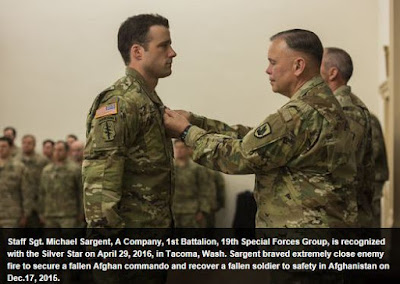
In all, the soldiers earned the Silver Star, two Bronze Stars with V device, six Army Commendation Medals with V device, and one Purple Heart. “These men are heroes, plain and simple,” said Maj. Gen. Bret Daugherty, adjutant general of the Washington National Guard, during the ceremony, according to information released by the Army. “They don’t boast. They don’t draw undue attention to themselves. They just get the job done.”
The men of A Company deployed to Afghanistan in July, and they were tasked with developing and partnering with members of the Afghan National Security Forces. Their teammate, Sgt. 1st Class Matthew McClintock, 30, was killed Jan. 5 in hours-long fighting near the city of Marjah, in Afghanistan’s Helmand province. McClintock was posthumously promoted and awarded the Silver Star for his actions on that day; McClintock’s wife, Alexandra, has said her husband’s teammates told her he left a compound, under fire, to find a new landing zone so a helicopter could land and evacuate a wounded teammate.
Many of the awards presented last week were to McClintock’s teammates for their actions during that same battle. “The men we honored today, including those who were unable to be with us, represent the best of what is inside all of those who serve this great nation,” said Maj. Aron Horiel, commander of A Company, according to the Army. “It is truly an honor and a privilege to be their commander.”
Sargent, a Special Forces engineer sergeant, was awarded the Silver Star for his actions on Dec. 17. On that day, Sargent was an assault team leader during a clearing operation in Khan Neshin Valley in Helmand province, according to the narrative accompanying his award. Early that morning, Sargent and his fellow Green Berets were accompanying a team of Afghan commandos as they entered a courtyard adjacent to their objective, according to the narrative. A brief firefight broke out, and two Afghan soldiers were killed.
The remaining commandos reported back to their Green Beret mentors. Initial reports were unclear if the two Afghan casualties were killed or wounded, but the Afghans informed the Americans that the courtyard was clear, according to the narrative.
Sargent and three others entered the courtyard to help recover the two Afghan soldiers. After confirming the two men were dead, “the element came under intense automatic weapons fire at very close range from firing positions in a structure adjacent to the courtyard,” according to the narrative.
Two Americans were wounded in the initial burst of fire. That left Sargent and another soldier alone in the courtyard, according to the narrative. “With total disregard for his safety, SSG Sargent moved to the casualty closest to his position, retrieved the body and dragged the deceased [Afghan] soldier out of the courtyard under a hail of gunfire,” the narrative says. “Upon exiting the courtyard to relative safety, SSG Sargent returned into the courtyard without hesitation and recovered the second body and aided the remaining teammate still under fire.”
During this time, a fire to the structure containing the enemy firing position began to burn, setting off “large secondary explosions,” according to the narrative. “Again with total disregard for his safety, SSG Sargent moved through intense enemy fire and secondary explosions and employed two hand grenades into the fighting position to cover the withdrawal of his team members,” the narrative says.
When the enemy tried to “assault out of the fighting positions,” Sargent and his remaining teammate killed five of them, according to the narrative. Sargent “distinguished himself by exceptional heroism,” and “his actions proved critical in achieving relative superiority over determined enemy forces,” Sargent’s Silver Star citation reads.
Article from Army Times, 6 May 2016
For his actions on that day in December, Sargent was awarded the Silver Star, the nation’s third-highest award for valor. Sargent and several other members of A Company, 1st Battalion, 19th Special Forces Group were honored last Friday for their actions during their recent deployment to Afghanistan.

In all, the soldiers earned the Silver Star, two Bronze Stars with V device, six Army Commendation Medals with V device, and one Purple Heart. “These men are heroes, plain and simple,” said Maj. Gen. Bret Daugherty, adjutant general of the Washington National Guard, during the ceremony, according to information released by the Army. “They don’t boast. They don’t draw undue attention to themselves. They just get the job done.”
The men of A Company deployed to Afghanistan in July, and they were tasked with developing and partnering with members of the Afghan National Security Forces. Their teammate, Sgt. 1st Class Matthew McClintock, 30, was killed Jan. 5 in hours-long fighting near the city of Marjah, in Afghanistan’s Helmand province. McClintock was posthumously promoted and awarded the Silver Star for his actions on that day; McClintock’s wife, Alexandra, has said her husband’s teammates told her he left a compound, under fire, to find a new landing zone so a helicopter could land and evacuate a wounded teammate.
Many of the awards presented last week were to McClintock’s teammates for their actions during that same battle. “The men we honored today, including those who were unable to be with us, represent the best of what is inside all of those who serve this great nation,” said Maj. Aron Horiel, commander of A Company, according to the Army. “It is truly an honor and a privilege to be their commander.”
Sargent, a Special Forces engineer sergeant, was awarded the Silver Star for his actions on Dec. 17. On that day, Sargent was an assault team leader during a clearing operation in Khan Neshin Valley in Helmand province, according to the narrative accompanying his award. Early that morning, Sargent and his fellow Green Berets were accompanying a team of Afghan commandos as they entered a courtyard adjacent to their objective, according to the narrative. A brief firefight broke out, and two Afghan soldiers were killed.
The remaining commandos reported back to their Green Beret mentors. Initial reports were unclear if the two Afghan casualties were killed or wounded, but the Afghans informed the Americans that the courtyard was clear, according to the narrative.
Sargent and three others entered the courtyard to help recover the two Afghan soldiers. After confirming the two men were dead, “the element came under intense automatic weapons fire at very close range from firing positions in a structure adjacent to the courtyard,” according to the narrative.
Two Americans were wounded in the initial burst of fire. That left Sargent and another soldier alone in the courtyard, according to the narrative. “With total disregard for his safety, SSG Sargent moved to the casualty closest to his position, retrieved the body and dragged the deceased [Afghan] soldier out of the courtyard under a hail of gunfire,” the narrative says. “Upon exiting the courtyard to relative safety, SSG Sargent returned into the courtyard without hesitation and recovered the second body and aided the remaining teammate still under fire.”
During this time, a fire to the structure containing the enemy firing position began to burn, setting off “large secondary explosions,” according to the narrative. “Again with total disregard for his safety, SSG Sargent moved through intense enemy fire and secondary explosions and employed two hand grenades into the fighting position to cover the withdrawal of his team members,” the narrative says.
When the enemy tried to “assault out of the fighting positions,” Sargent and his remaining teammate killed five of them, according to the narrative. Sargent “distinguished himself by exceptional heroism,” and “his actions proved critical in achieving relative superiority over determined enemy forces,” Sargent’s Silver Star citation reads.
Article from Army Times, 6 May 2016
Tuesday, February 2, 2016
SFC Martland Update
Congressman Duncan Hunter citing Green Beret SFC Charles Martland's plight, adds to Army secretary controversy and continues his fight to keep the decorated Green Beret in uniform, by putting a hold on Eric Fanning’s nomination to be the next Army secretary.
“My support for your action, as you also stated yourself, is nothing personal,” Hunter, a Republican from California and former Marine officer, wrote in a letter to Sen. Pat Roberts. “The ability of any senator to hold a nomination is an effective mechanism to ensure the executive branch is forthright, transparent and accountable.”
Roberts, R-Kan., placed a hold on Fanning’s nomination last fall. A "hold," permitted by Senate procedures, prevents a vote from reaching the Senate floor. Roberts placed a similar hold on former Army Secretary John McHugh’s nomination in 2009 when he learned that Fort Leavenworth, home to the U.S. Disciplinary Barracks in Kansas, was being studied as a potential site for relocating prisoners if the facility in Guantanamo Bay, Cuba, is closed. McHugh retired Nov. 1.
Fanning, who was nominated in September for the Army’s top civilian job, appeared before the Senate Armed Services Committee last week for his confirmation hearing.
Army Under Secretary Patrick Murphy, who was sworn in Jan. 5, is serving as acting secretary. It’s unclear now when or if Fanning might be confirmed. In his letter to Roberts, sent Wednesday morning, Hunter asked the senator to consider the case of Sgt. 1st Class Charles Martland as part of his hold.

Martland, who Hunter described as a “first-rate warrior,” is being kicked out of the Army for beating an alleged child rapist in Afghanistan. In October, he was given a 60-day reprieve to file an appeal with the Army Board for the Correction of Military Records after Rep. Mac Thornberry, R-Texas, chairman of the House Armed Services Committee, spoke with and wrote a letter to McHugh.
Martland and his then-detachment commander have admitted to attacking an Afghan Local Police commander in Kunduz province in 2011. Martland, a Bronze Star recipient and 11-year veteran, has re-enlisted and served since then and wants to remain in the Army. He was flagged for involuntary separation through the Army’s qualitative management program because of his role in the assault.
Martland has gained many supporters, including Hunter and the VFW, and many consider him a hero for his actions. Hunter, in his letter to Roberts, also noted that Martland has the “full support of his command and immediate leadership.”
Since he was granted the 60-day reprieve, Martland has resubmitted an appeal to the QMP decision. “Recently, a decision within Army Human Resources Command recommended that the Army uphold the judgment that Martland be removed from service, although a final decision has yet to be made about his future,” Hunter wrote in the letter. “My own position: I am not offended by, nor do I take any issue with, Martland’s confrontation of the child rapist. Martland was part of a small team of Green Berets, entrusted to keep America safe in ways that often go unreported or unnoticed, whose mission was being put at risk due to the illegal action of a corrupt ALP commander.”
Hunter went on to ask Roberts to “consider the case of Charles Martland as the confirmation process for Eric Fanning continues. The only suitable course of action, I firmly believe, is to permit Martland to continue his service in the U.S. Army.”
Martland’s case now goes back to the Army Board for the Correction of Military Records for a final determination, said Joe Kasper, Hunter’s chief of staff.
Hunter wrote to Roberts in an effort to publicly declare his support for the senator but also to encourage the Army to do the right thing, Kasper said.
“You’ve got a guy who’s able-bodied, knowledgeable, who can do something beneficial in so many ways, whether it’s applying his craft in the war zone or educating and training other NCOs. Instead he’s just in limbo while bureaucrats keep shuffling their feet,” Kasper said. “We’re left with no option than to push the issue through this way. If the Army truly, truly wants to do the right thing here, it’s there for them to do. Tell me [Martland is] not the kind of guy you want to retain, just because he slapped around a child rapist who deserved what he got.”
Article from Army Times
Friday, January 8, 2016
Green Berets Surrounded in Southern Afghanistan
The following article is from SOFREP, published under the title "Washington Policy Leaves Special Forces Soldiers Flapping in the Breeze in Marjah, Afghanistan".
It took so long to launch the Quick Reaction Force (QRF) to help out Green Berets pinned down and under fire in Marjah, Afghanistan that it would have been faster to deploy a team from another continent rather than wait for the theater commanders in Afghanistan to let a nearby Special Forces team go to help their team mates.
With a team from 19th Special Forces Group attached to 3rd Special Forces Group surrounded and under fire in Marjah, Afghanistan their QRF should have been launched far sooner. It wasn’t the fault of the actual soldiers, who were standing by and ready to go, but command would not let them leave their base, insisting that they wait for the next period of darkness before a team from 19th Special Forces Group was able to drive in and conduct a off-set infil to support their fellow Green Berets.
The 19th Group Team was there as part of a broader effort to re-take Marjah from the Taliban, and was coordinated with local Afghan units which were clearing adjacent valleys. Once pinned down, one team member was killed, another seriously injured. A Special Forces medic (18D) worked on the casualty for 12-hours, keeping him alive while receiving enemy fire. The casualty, “was alert and oriented” by the time he was finally evacuated according to one SOFREP source.

The Green Beret KIA was SSG Matthew McClintock, 30, of Albuquerque, New Mexico (picture at right with his son). SSG McClintock also leaves behind a wife. "SSG McClintock was one of the best of the best," said MG Bret Daughtery, Commander of the Washington National Guard. McClintock was assigned to the 19th SFG, Washington National Guard. "He was a SF engineer, or 18C. Our condolences and prayers from go out the to the family of this Fallen Hero. May he Rest In peace."
Worse yet, command would not authorize fire support from a circling AC-130 gunship due to fears of collateral damage. Recent events such as the hospital bombing in Kunduz probably resonate at command levels, but perhaps they should have been thinking more about another recent event, Benghazi, since their men on the ground faced the threat of being overrun. Eventually, the command allowed AC-130 to fire a whopping two 40mm rounds into an open field a weak show of force to the Taliban.
3rd Group Green Berets have often complained about the leadership failures experienced while in theater in Afghanistan. Part of the problem is that they end up working for NATO Special Operations Component Command – Afghanistan (NSOCC-A). “We have so many fucking Generals that don’t do shit,” one Special Forces soldier said in disgust. “Every base I go to I trip over 50 majors, 30 LTCs, and see 6 Generals.” Entire advisory teams and separate military commands are invented in Afghanistan simply so that officers can be deployed and hold a “command” which will get them promoted.
One spot of good news is that the Afghan Local Police (ALP), Afghan National Army (ANA) Special Forces, and Afghan Commandos have turned out to be strong allies in fighting the Taliban. “They are really doing their job…but you won’t read that in the news,” a Green Beret told SOFREP.
It took so long to launch the Quick Reaction Force (QRF) to help out Green Berets pinned down and under fire in Marjah, Afghanistan that it would have been faster to deploy a team from another continent rather than wait for the theater commanders in Afghanistan to let a nearby Special Forces team go to help their team mates.
With a team from 19th Special Forces Group attached to 3rd Special Forces Group surrounded and under fire in Marjah, Afghanistan their QRF should have been launched far sooner. It wasn’t the fault of the actual soldiers, who were standing by and ready to go, but command would not let them leave their base, insisting that they wait for the next period of darkness before a team from 19th Special Forces Group was able to drive in and conduct a off-set infil to support their fellow Green Berets.
The 19th Group Team was there as part of a broader effort to re-take Marjah from the Taliban, and was coordinated with local Afghan units which were clearing adjacent valleys. Once pinned down, one team member was killed, another seriously injured. A Special Forces medic (18D) worked on the casualty for 12-hours, keeping him alive while receiving enemy fire. The casualty, “was alert and oriented” by the time he was finally evacuated according to one SOFREP source.

The Green Beret KIA was SSG Matthew McClintock, 30, of Albuquerque, New Mexico (picture at right with his son). SSG McClintock also leaves behind a wife. "SSG McClintock was one of the best of the best," said MG Bret Daughtery, Commander of the Washington National Guard. McClintock was assigned to the 19th SFG, Washington National Guard. "He was a SF engineer, or 18C. Our condolences and prayers from go out the to the family of this Fallen Hero. May he Rest In peace."
Worse yet, command would not authorize fire support from a circling AC-130 gunship due to fears of collateral damage. Recent events such as the hospital bombing in Kunduz probably resonate at command levels, but perhaps they should have been thinking more about another recent event, Benghazi, since their men on the ground faced the threat of being overrun. Eventually, the command allowed AC-130 to fire a whopping two 40mm rounds into an open field a weak show of force to the Taliban.
3rd Group Green Berets have often complained about the leadership failures experienced while in theater in Afghanistan. Part of the problem is that they end up working for NATO Special Operations Component Command – Afghanistan (NSOCC-A). “We have so many fucking Generals that don’t do shit,” one Special Forces soldier said in disgust. “Every base I go to I trip over 50 majors, 30 LTCs, and see 6 Generals.” Entire advisory teams and separate military commands are invented in Afghanistan simply so that officers can be deployed and hold a “command” which will get them promoted.
One spot of good news is that the Afghan Local Police (ALP), Afghan National Army (ANA) Special Forces, and Afghan Commandos have turned out to be strong allies in fighting the Taliban. “They are really doing their job…but you won’t read that in the news,” a Green Beret told SOFREP.
Wednesday, November 25, 2015
Army Special Forces Veterans Among Those Targeted in Cyberattack

Letters have been going out for at least three weeks to veterans of the elite force, letting them know that their Social Security numbers and other information provided for prior background investigations were stolen, according to a retired Special Forces master sergeant who provided Military.com with a copy of the letter on condition of anonymity.
"It's disgusting that we risk our lives to defend this nation and that the government cannot defend our most sensitive records or our families records," the retired senior noncommissioned officer said. U.S. intelligence officials say the hacks were carried out by China.
In response to Military.com's request for comment, OPM provided a link to its original announcement and guidance on the breach. The office in June announced it had discovered two hacks affecting some 21.5 million Americans, including military personnel and veterans.
OPM Acting Director Beth Cobert, who on Nov. 10 was nominated by President Obama for a four-year term as the agency's permanent director, revealed in the recent letter to the retired Special Forces master sergeant that her own information had been hacked.
"As someone whose information was also taken, I share your concern and frustration and want you to know we are working hard to help those impacted by this incident," she said.
Because of the breach, the federal government is going to provide everyone whose data was stolen, as well as their minor children, with identify theft protection, including credit monitoring, identity theft insurance and identity restoration services for three years.
She said the identify protection services have already been put in place.
Government officials at the time said the second of two hacks targeted military records, including sensitive information provided by intelligence and military personnel for security clearances. The forms believed taken at the time included Standard Form 86, which require applicants to detail sensitive personal information about mental illnesses, drug and alcohol use, past arrests and bankruptcies, The Associated Press reported.
In the letter given to Military.com, OPM stated, "If you applied for a position or submitted a background investigation form, the information in our records may include your name, Social Security number, address, date and place of birth, residency, educational and employment history, personal foreign travel history, information about immediate family as well as business and personal acquaintances and other information used to conduct and adjudicate your background."
For family members listed on a spouse or co-habitant's form, the information available to hackers would include name, Social Security number, address, date, place of birth and, in some cases, citizenship information, according to the letter.
The names of contacts and relatives potentially expose any foreign relatives of U.S. intelligence employees to coercion, the AP reported.
Article from Military.com
Thursday, November 12, 2015
Controversial Green Beret Retires Quietly With High Award

“Intentionally or not, it was an admission of guilt” for subjecting the war hero to a criminal probe last year because he had discussed the FBI’s poor hostage-rescue record with a member of Congress, said an Army officer who attended the ceremony. The officer spoke on a not-for-attribution basis because of the issue’s continuing sensitivity.
At the time he spoke with the member of Congress, Lieutenant Colonel Amerine was in charge of the Army’s effort to find and rescue Sergeant Bowe Bergdahl.

Amerine was one of the Army’s most celebrated soldiers for his heroic actions in combat in Afghanistan soon after the terrorist attacks of September 11, 2001.
Vastly outnumbered by the Taliban, his team (see picture at left) earned three Silver Stars, seven Bronze Stars and 11 Purple Hearts for routing the insurgents. His story was immortalized in The Only Thing Worth Dying For, a New York Times best-seller.
In January 2002, President George W. Bush made him a guest of honor at his State of the Union address (see picture at top). But Amerine ran afoul of the FBI when he told Representative Duncan Hunter, a Marine veteran and Republican member of the House Armed Services Committee, how bureaucratic politics had scuttled a deal he had worked out with the Taliban for Bergdahl’s release.
When the FBI learned of Amerine’s criticism, it complained to the Army’s chief of staff for intelligence, General Mary Legere, who prompted the Criminal Investigation Command to open an investigation. Amerine’s pay was halted, he was booked and fingerprinted, and his retirement was put on hold. Bergdahl, meanwhile, was released on far worse terms than Amerine worked out, according to a Newsweek investigation in September.
Friday’s ceremony “was beautiful, just an amazing moment,” Amerine said in an interview with Newsweek. In a statement he was preparing for his Facebook page, he called the retaliation against him “inevitable, because our First Amendment right to speak to Congress is so often disregarded by our own government.”
But he also refused to blame the Army as a whole for the “runaway” investigation of him. “It was Greek tragedy that a senior Army officer dragged the Army ignominiously into this by initiating the illegal investigation,” he said. “The hostage issues I raised had nothing to do with the Army and everything to do with broken institutions at the agency level that refused to admit their faults. At least the fratricide was not lethal this time. But it soiled all of us.”
Upwards of 60 supporters attended Friday’s ceremony, held in a small amphitheater in the Pentagon basement. One of them was Danielle Brian, executive director of the Project on Government Oversight (POGO), a private Washington, D.C.-based group that champions whistleblowers who expose government waste, fraud and abuse. “For nearly a year, LTC Jason Amerine, a true American hero, has been under criminal investigation for speaking to Congress about the US's totally dysfunctional hostage recovery process,” Brian said in a statement for Newsweek. ”When anyone brings concerns of wrongdoing to Congress they are supposed to be protected under the law. But in fact, it took Jason assembling his ‘last guerrilla army’ of Congressional supporters, POGO, and a few courageous military officers acting behind the scenes to prevent a court martial.”
Brian praised Hunter’s support for Amerine and blasted the Pentagon’s inspector general for “spectacularly” failing to protect Amerine’s whistleblower rights. “It is time to get his mugshot, fingerprints and DNA removed from the criminal database and tackle the organizations and laws that failed him,” she said.
An Army spokeswoman said the Army would have no comment until Monday. The Legion of Merit is “one of the U.S. military's most prestigious awards, ranking just below the Silver Star, and ahead of the Distinguished Flying Cross,” according to the Army Times newspaper. “It is one of only two decorations to be issued as neck wear, the other being the Medal of Honor.”
Amerine wrote that he could not thank his friends and supporters “enough for standing by me all these months. Instead of highlighting anyone, I will simply thank everyone. I don’t write this to declare victory; the issue was the hostages and I was a distraction from my own cause.” “The U.S. ability to free them is finally being repaired,” he added, “but has a long, long way to go before it is more than an ad hoc solution to a crisis we took too long to identify.”
Article from Newsweek
Wednesday, October 7, 2015
How the OSS Shaped the CIA and American Special Ops

Wild Bill Donovan’s admirers and critics still argue over his legacy, but on one point they agree: His World War II Office of Strategic Service (OSS) became the Petri dish for the spies who later ran the CIA as well as the special operators who conduct some of the most daring raids the world has ever seen. Picture of Will Bill Donovan is at right.
Four CIA directors — Allen Dulles, Richard Helms, William Colby and William Casey — learned the craft of clandestine warfare as operatives for Donovan’s OSS. Indeed, the daring, the risk-taking, the unconventional thinking, and the élan and esprit de corps of the OSS permeated the new agency.

So would the OSS’s failings: the delusions that covert operations, like magic bullets, could produce spectacular results, or that legal or ethical corners could be cut for a higher cause. Dulles launched the calamitous operation to land CIA-trained, anti-Castro guerrillas at Cuba’s Bay of Pigs. Helms was convicted of lying to Congress about the CIA’s effort to oust President Salvador Allende in Chile. Colby would become a pariah among the agency’s old hands for releasing to Congress what became known as the “Family Jewels” report on CIA misdeeds during the 1950s, ‘60s, and early ‘70s. Casey would nearly bring down the CIA — and Ronald Reagan’s presidency — from the scheme to secretly supply Nicaragua’s Contras with money raked off from the sale of arms to Iran in exchange for American hostages in Beirut.
Few appreciate how remarkable it was that President Franklin Roosevelt appointed William J. “Wild Bill” Donovan, in July 1941, to be the head of an intelligence organization called the Coordinator of Information, later renamed the Office of Strategic Services. Donovan was a Republican, Roosevelt was a Democrat, and the two had a history of fierce political battles in New York. But to Roosevelt, Donovan — a hero of the Great War and part of the Republican Party’s internationalist wing — was the only one who seemed to be thinking seriously about how to set up a worldwide foreign intelligence service, which FDR desperately needed as the cyclone of World War II approached the United States.
Donovan started with just one man — himself. By the end of the war, he had been promoted to major general and had assembled a force of more than 10,000 spies, saboteurs, commandos, propagandists, research analysts, and support personnel operating in stations all over the world. He had clandestine officers who stole secrets from the Axis, guerrillas who fought behind enemy lines, some of the country’s finest minds analyzing the intelligence, and psychological warfare specialists who tried to sap enemy morale.
Based in Switzerland, Dulles ran the OSS’s most successful spy operation against the Third Reich. Casey organized dangerous missions to penetrate Nazi Germany. Colby led daring commando raids into occupied France and Norway. Helms mounted risky intelligence programs against the Russians in war-torn Berlin just after the German surrender.
After FDR died, President Harry Truman, who was not close to Donovan and had received derogatory reports on the OSS and its director, shut down the agency on October 1, 1945, and parceled out its functions to the Pentagon and State Department. Truman was not blind to the need for a foreign intelligence service to spy on future Cold War threats. He just didn’t want Donovan and his OSS leading it. In 1947, however, Truman created the Central Intelligence Agency, whose organization practically mirrored the postwar spy service Donovan had in mind and was staffed by a number of OSS alumni.
Dulles ran the CIA as he had his OSS station in Switzerland. He believed that intelligence was a key part of American foreign policy and that the network of associations, the breadth of vision and the daring he had displayed fighting the Nazis would succeed in battling communism. Spying during the war and afterwards was a gentleman’s pursuit, he believed, practiced in the shadows by and among “men of affairs” like him, who were comfortable bending ethics or cutting legal corners for a higher cause. Though he talked little about Donovan after the war, Dulles’s operating style mirrored the general’s in many ways. Like Donovan, Dulles showed no interest in managing the CIA’s inner workings, leaving them to his deputies so he could be free to dabble in the clandestine operations that interested him.
Helms, who took over the CIA in 1966, had no vision for recasting the agency as Dulles had. His strength, as it had been in postwar Berlin, was management, not innovation. He was also determined to keep the CIA out of the headlines, ordering division heads to scrub covert operations overseas for security and shut down the ones in danger of being exposed. Though Helms was a demanding taskmaster, subordinates groused that he was too soft on the “old boys club” of former OSS officers in the agency, which needed shaking up. Helms wanted to keep his distance from old World War II spy pals so he wouldn’t be seen as playing favorites as director, but play favorites he did. He pulled OSS officers’ children who had joined the CIA out of meetings to give them a special welcome in his seventh-floor office at Langley. He often balked at firing veterans who misbehaved overseas, instead finding out-of-the-way jobs for them in headquarters.
Colby, who liked to putter around his Bethesda, Maryland home wearing his floppy Army fatigue cap from World War II, was profoundly affected by his OSS experience, say friends and relatives. As Director of Central Intelligence he drove his own car to work, ate with employees in the cafeteria, called in young analysts to compliment them on their reports and suggest ways their work could be improved, and found time in his schedule to listen to any employee walking in with a complaint. Like Donovan, he believed the mundane work of information gathering often produced more valuable intelligence than a Mata Hari-style escapade. With advances in electronic intelligence gathering, the human spy was a “contributor, but not the sole actor,” he said.
Casey hung two photos on the wall of his seventh-floor office — portraits of Ronald Reagan and Wild Bill Donovan. He ran the CIA the way he thought the general would. Like Donovan, he kept his door open to all ideas for operations. He hated bureaucracy, circumvented the chain of command, and poked his head into offices rungs below. He was proud, as Donovan had been, of the vast array of PhDs working at Langley. Like Donovan, he loved to tour his overseas stations, not only to boost morale and size up field officers who worked for him but also to leave Washington’s political wars behind. When he returned, he always delivered vivid trip reports to President Reagan, just as Donovan had done with Roosevelt.
Today, a statue of Donovan, commissioned by Casey when he was Director of Central Intelligence, stands in the main foyer of the CIA’s headquarters building — a symbolic reminder that Donovan was the father of modern American espionage. The basic skills agency officers practice today differ little from those of their OSS predecessors, save for more modern technology.
The U.S. Special Operations Command (USSOCOM) also claims an OSS lineage. Donovan’s special operations teams, for example, supplied partisans with weapons to fight the Nazis in Yugoslavia. His Detachment 101 organized guerrilla attacks against Japanese military targets in Burma. The OSS also fielded more than a thousand highly trained, foreign language-speaking paratroopers, skilled in sabotage and small-arms tactics, who were used in small groups to harass the enemy. These Operational Group commandos, called OG’s, fought behind the lines in France and Italy. A glass-enclosed case, full of Donovan memorabilia, sits in the main foyer of USSOCOM’s Tampa, Florida headquarters. The command’s leaders have held brainstorming sessions to explore what this modern force can learn from its roots and how it can emulate the special operations fighters of the OSS.
Donovan can also be considered the father of the psychological operations USSOCOM and the CIA wage. In the OSS, these were called morale operations and the technology used was, in some cases, far cruder than the kind used in today’s dark arts. Donovan’s officers planted rumors in newspapers claiming that top Nazis were abandoning Germans and fleeing to South America, dropped leaflets on Wehrmacht soldiers, and beamed radio broadcasts at them with propaganda messages mixed with songs by Marlene Dietrich.
Clearly, Donovan was one of the men who shaped modern unconventional warfare. Today’s shadow warriors who practice espionage, launch covert attacks, or try to change hearts and minds overseas can trace their heritage back to the OSS and its band of “glorious amateurs.”
Article by Douglas Waller from War on The Rocks
Douglas Waller is an author, lecturer, and former correspondent for Time magazine. He is the author of Disciples: The World War II Missions of the CIA Directors Who Fought for Wild Bill Donovan (Simon & Schuster) which will be released on October 6. He also wrote Wild Bill Donovan: The Spymaster Who Created the OSS and Modern American Espionage (2011), described by Booklist as “the definitive biography of a seminal figure in the history of American intelligence.”
Tuesday, June 9, 2015
Special Forces officer under investigation by Army called to testify at whistleblower hearing

Lt. Col. Jason Amerine was invited to testify June 11 before the Senate Homeland Security and Governmental Affairs Committee, said Patrick McIlheran, a spokesman for Sen. Ron Johnson (R.Wis.), who is chairman of the committee. The hearing is called “Blowing the Whistle on Retaliation: Accounts of Current and Former Federal Agency Whistleblowers.”
“As always, Chairman Johnson hopes the witness will be able to provide good information to the committee,” McIlheran said. “He will wait to comment until after he hears the testimony.”
Amerine has been under investigation by Army Criminal Investigation Command for four months, he said in a Facebook post May 15. He alleged the probe was launched after the FBI complained that he was speaking with officials on Capitol Hill about U.S. hostage recovery efforts, in which he played a leading role at the Defense Department. Amerine has been credited by Rep. Duncan D. Hunter (R.Calif.) in helping to develop an amendment that calls for President Obama to appoint a specific federal official to oversee hostage tracking and recovery.
“This bill helps to resolve the FBI’s impotence to help our hostages overseas as well as our government’s disorganized efforts across all agencies,” said Amerine, in his post. He has declined to comment further. “The bureaucracy is broken; this is not about party politics and requires both parties to come together to achieve a solution as they are attempting in this bipartisan effort. But the Army somehow thought it made sense to initiate a CID investigation into me executing both my duty and my right to speak to Congress.
“If I learned nothing in my 22 years of service I learned that we never leave people behind,” he concluded. “This Bill makes it past the Senate and gets signed or it doesn’t but I will be damned if we didn’t try.”
Paul Bresson, a spokesman for the FBI, and Chris Grey, a spokesman with Army CID, declined to comment. Grey has previously disputed that Amerine is being investigated as an act of reprisal.
“We reject any notion that Army CID initiates felony criminal investigations for any other purpose than to fairly and impartially investigate credible criminal allegations that have been discovered or brought forward,” Grey said last month. “As a matter of policy, we do not confirm the names of individuals who may or may not be under investigation to protect the integrity of a possible ongoing investigation, as well as the privacy rights of all involved.”
Amerine said in his Facebook post that he had raised his concerns to Congress about the FBI’s “failed efforts” to recover Warren Weinstein, an aid worker who was accidentally killed in a U.S. drone strike near the Pakistani border earlier this year, and Caitlan Coleman, an American who was traveling in Afghanistan while pregnant when she was kidnapped in 2012. It is believed that she remains in captivity with her husband and child.
The case pits the Army against one of the first heroes of the Afghanistan War. Amerine commanded a Special Forces team there in 2001, working alongside former Afghan President Hamid Karzai before he became the interim leader of Kabul’s fledgling government followed the fall of the Taliban. Amerine’s time there ended Dec. 5, 2001, when he was wounded by an American bomb that killed three other Special Forces soldiers in a friendly-fire incident.
Hunter’s office has advocated fiercely for Amerine in recent days. In a May 28 letter to Army Secretary John McHugh, Hunter wrote that he was disappointed to hear that Amerine’s planned retirement after 22 years of service has been delayed “due to a baseless and retaliatory investigation.”
“For the record, I have personally met with senior officials within the FBI, and I have been provided a clear understanding of where and how the informal complaint against Amerine originated,” Hunter wrote, without elaborating. “Based on this interaction and the information provided, it remains my firm belief that the Army investigation, as it currently stands, is strictly retaliatory and has severely exceeded the appropriate timeframe for reviewing such a complaint.”
Hunter also said in the letter that Amerine’s approved retirement orders have been revoked, and his security clearance has been suspended. Amerine also no longer works on hostage recovery. The congressman has called for McHugh to review the case.
An Army spokesman, Lt. Col. Ben Garrett, confirmed that his retirement orders were revoked, and that Amerine’s pay was incorrectly stopped due to an administrative error. That error has since been corrected, he said. Amerine is currently assigned to the Army’s operations and technology office in Arlington, Va., Garrett said.
Amerine received the Bronze Star with “V” and the Purple Heart for service in Afghanistan. The Army later labeled him a “Real Hero” in the 2006 version of its popular video game, “America’s Army.”
More recently, Amerine wrote a book with author Eric Blehm, “The Only Thing Worth Dying For,” that was published in 2011.
Amerine’s team wanted to recover Weinstein along with Army Sgt. Bowe Bergdahl, the American soldier who went missing in 2009 and was recovered last May, as well as Coleman, her husband Joshua Boyle and their child, born in captivity. Two other Westerners also would have been included, but they have not been identified for their own security, said a spokesman of Hunter’s, Joe Kasper.
Under Amerine’s plan, they all would have been swapped for Haji Bashir Noorzai, an Afghan drug lord who had links to the Taliban, but also helped U.S. military officials find insurgent weapons caches in Afghanistan. He was convicted of drug trafficking and sentenced to life in prison after being lured to the United States in 2005.
It is unclear how the swap would have worked. Weinstein was held in Pakistan by al-Qaeda, while Bergdahl was held by a group with links to the Taliban. Bergdahl was turned over to a U.S. Special Operations team in Afghanistan on May 31, 2014, in a controversial swap in which five Taliban officials were released.
Chapter IX Commo Sergeant's comment: Jason Amerine is known to a couple of this Chapter's members as an outstanding Special Forces Officer of the highest integrity.
Article by the Washington Post
Friday, June 5, 2015
Special Ops to Obama: Let Us Fight ISIS, Already

“We recognize this is a longterm prospect,” said Gen. Joseph Votel, the overall leader of U.S. Special Operations Command, in remarks to The Daily Beast during a special operations forum in Tampa. “We’re patient.”
“We talk about it being a 15-year struggle,” added Lt. Gen. Bradley Heithold, who heads the Air Force Special Operations Command, said describing the fight.
But many special operations officers and troops both in Tampa and Washington don’t want to wait that long to take the fight to ISIS. They were eager to talk about their aggravation over fighting by remote in Iraq and Syria: having to advise Iraqis, Kurdish Peshmerga, and rebel Syrian fighters from afar instead of joining them in battle.
“We are doing everything through cellphones… It’s hard to do much when you can’t go outside the wire,” said one special operator, using the military jargon for the perimeter of a base.
They blame the hands-off approach on an Obama administration unwilling to risk even small numbers of American lives in battle, burned by the fallout of the loss of four Americans in Benghazi, Libya, and intent on preserving the legacy of President Barack Obama’s troop drawdowns in Iraq and Afghanistan.
“You can’t say ‘We’re with you every step of the way, except when you are going on combat operations,’” said a former senior special operations official briefed on the ISIS campaign.
He and many other officers, current and former, at the conference believe both Mosul and Ramadi could have withstood the assault of the so-called Islamic State, also known as ISIS, if a small number of U.S. military advisers had been working with Iraqi forces at the front lines.
They spoke on condition of anonymity because they were not authorized to publicly discuss the debates over war strategy.
“They know as long as there are Americans with them, that if they get in trouble, there is intelligence,” and medical evacuation, the former senior official said. “They don’t have faith in their own chain of command to do it, so rather than being captured and slaughtered by ISIS, they’ll break and run.”
Another former senior special operations officer said this is the normal tension that occurs every few years between America’s political leadership that weighs the public’s reaction to U.S. casualties, and a group of professional risk-takers who want to fight alongside those they’ve trained to fight.
“It’s a generational thing,” said the officer, who said U.S. forces were similarly frustrated when training Nicaraguan forces in the 1980s. “Every few years, there is a place where the U.S. administration won’t let U.S. forces accompany those they’ve trained,” the officer said. “This younger generation has to get over it.”
U.S. Central Command’s program to train Syrian rebels—a special operations mission—has been delayed partly by congressional funding delays, and partly because it’s been difficult to find trustworthy candidates without being inside Syria, according to current and former U.S. officials involved in the process.
Votel said he hadn’t heard that vetting was a problem, nor had he heard frustrations expressed over the pace of the fight.
But faced with the necessity of having to fight by remote, the special operations commanders asked industry members present at the National Defense Industry Association conference to find new ways for the Americans to communicate remotely with foreign partners in the field—a necessity in places like Syria, where U.S. troops rely on Kurdish and other foreign partners to relay intelligence and targeting information by cellphones that can be hacked or intercepted.
The head of the Navy SEALs, Rear Adm. Brian Losey, said the nature of the fight is changing who they’re recruiting, with SEALs needing to raid one day, and work with dipomats, intelligence officers, and foreign officials the next.
“We’ve started to put more value on intellect,” Losey said, with almost half the incoming enlisted SEALs in the past two years having college degrees.
Frequently working in small, far-flung teams, “they are representing America all by themselves,” he said.
While some of the special operations commanders at the conference privately voiced concern over ISIS’s recent advances, they all said this will be a decades-long war that requires a lot more than U.S. military firepower to win.
“In this struggle, you don’t kill your way to victory,” added Heithold. “You do have to put pressure on the leadership in order to affect them. But it is not in itself the answer.”
“That’s why we talk about it being a 15-year struggle,” he said.
“We can continue to mow the grass and try to take ’em out, but it’s not a winning strategy,” added Lt. Gen. Charles Cleveland, the head of U.S. Army Special Operations Command. “We’re going to have to start thinking of root causes,” like instability or economic deprivation—something that the military can only really contribute to by training local forces, leaving the rest to other branches of government.
“We have to try to set the conditions so that 8-year-old today doesn’t become the jihadi in 10 years… or even less than that,” he said.
Article by Kimberly Dozier on the Daily Beast
Tuesday, April 21, 2015
COL James N. "Nick" Rowe, true American Hero

Rowe was a West Point graduate of 1960 and was subsequently commissioned as a second lieutenant in the United States Army. In 1963, then First Lieutenant Rowe was deployed to Vietnam as Executive Officer of Detachment A-23, 5th Special Forces Group. The mission of A-23 was to organized a Civilian Irregular Defense Group (CIDG) for a basecamp in the Mekong Delta.
On October 29, 1963, Rowe was captured by Viet Cong elements along with Captain Rocky Versace and Sergeant Daniel Pitzer. Rowe spent 62 months in captivity in the U Minh Forest, most of this time in a cage. Over powering a guard, Rowe escaped captivity on December 31, 1968, and during evasion, managed to signal a Huey helicopter for recovery. Rowe subsequently wrote his account of captivity in the book Five Years to Freedom. Nick Rowe retired from active duty in 1974.

In 1987, Colonel Rowe was assigned to the U.S. Military Advisory Group (JUSMAG) in the Philippines providing training and advisory capabilities to the Filipino Army fighting the New People's Army (NPA), the communist insurgency.
In February 1989, Colonel Rowe warned that the NPA was planning on assassinating several prominent figures, himself included. On April 21, 1989 Colonel Rowe was assassinated in an ambush on his vehicle while traveling to JUSMAG headquarters.
Not only just the developer and driving force between the US Army Special Forces SERE school, there are facilities in the Philippines, Fort Huachuca and Fort Campbell named after COL James. N. "Nick" Rowe.
Camp MacKall, the Special Forces Training base at Fort Bragg was re-named the Rowe Training Facility. The infamous obstacle course that every Special Forces Candidates grew to hate is called the "Nasty Nick" and fittingly is called the hardest obstacle course in the military. And last, but not least, a High School and major Boulevard in Nick Rowe's hometown of McAllen are named after him. Special Forces and indeed this Country, owe a huge debt to this man.
Tuesday, March 10, 2015
AFRICOM’s Flintlock develops tactics to take on Boko Haram threat

The Flintlock exercise, the largest conducted by Special Operations Command Africa, brought together troops from several countries to work on a range of tactics to be deployed in fighting Boko Haram, which is based in Nigeria but threatens the stability of neighboring states.
“We find this year’s exercise both unique and very relevant,” Africa Command’s Gen. David Rodriguez said during Monday’s closing ceremony in Chad. “Because, as you know, here today in Ndjamena, we are not far removed from the immediate threat of Boko Haram.”
Eliminating the threat of violent extremists will require a multinational effort “involving political will, economic development and professional security forces,” Rodriguez said in remarks provided by his staff.
The exercise, which was hosted by Chad with outstation training sites in several other countries, comes as Boko Haram’s profile is on the rise.
On Saturday, the group’s leader — Abubakar Shekau — declared in an unconfirmed message allegiance to the Islamic State, raising concerns that the two terrorist groups might unite into a more formal alliance. Already, there have been some questions about Boko Haram’s picking up on some Islamic State propaganda tactics, such as carrying out choreographed beheadings on video.
During the past year, Boko Haram’s assaults have steadily intensified, both within northern Nigeria and now stretching into border areas with neighboring states such as Chad and Niger, which also participated in this year’s Flintlock.
A focal point of the exercise was boosting the communication capabilities of regional forces, Rodriguez said.
“For example, we have implemented a collaborative command-and-control and information-sharing system that will remain in place for our African partners to share operational information and intelligence with each other, the U.S. and other international partners,” Rodriguez said. “This capability was not just effective during the exercise. It has been extremely useful in real-world application.”
Boko Haram, which translates as “Western education is sinful,” aims to overthrow Nigeria’s secular government and install a strict form of Sharia law.
SFA Chapter IX Comment: Boko Haram has recently pledged allegiance to the Islamic State of Iraq and Syria (ISIS). Boko Haram operates in and controls much of Northeast Nigeria adjacent to the borders of Niger, Chad and Cameroon. While the Armies/Security Forces of Niger and Cameroon are challenged when fighting Boko Haram unilaterally, every time Chad Army units engage Boko Haram they come away with signifcant success.
For AFRICOM, exercises such as Flintlock are a way to increase the capabilities of indigenous forces, which are at the front lines in the fight against Boko Haram. Chad, Niger and Cameroon are among the countries that have pledged to increase their operations against the group.
While Boko Haram has put pressure on neighboring states, Nigeria has borne the brunt of the group’s attacks. About 1 million Nigerians have been displaced, and the government has struggled to find a way to contain the group, which has swept through swathes of the country’s north.
“We will continue to build upon the training we’ve accomplished and the lessons we’ve learned,” Rodriguez said. “We’ll remain focused on increasing regional military and civil cooperation and information flow, and cross-border coordination to combat violent extremist organizations.”
Article written by John Vandiver for Stars and Stripes
Monday, March 2, 2015
American business needs the Green Berets

Excellent article from Quartz.com, under the title "American business needs the Green Berets", written by Colin James Nagy who is the Executive Director of The Barbarian Group, on why American businesses should hire Green Berets.
I’ve been working on a pro-bono strategy project lately with my colleague Laura Robertson. The purpose? Help Special Forces soldiers (aka the Green Berets) transition after their service into the business world. There are plenty of other non-profits and efforts aimed at helping veterans move out of the armed forces, but there’s an especially strong match between this elite community and the private sector business—if we can translate between the two.
We’ve spoken to a range of transitioning Green Berets—those who have successfully launched business careers, civilian recruiters, as well as the staff of charitable foundations focused on transition. We’ve also immersed ourselves in the training, culture, structures and most importantly, the type of thinking taught to members of the Special Forces regiment.
First off, we determined there’s a significant branding issue that the community faces. The Special Forces (often referred to as “SF”) community exclusively refers to the Army’s soldiers focused on unconventional warfare and foreign internal defense, among other areas.
Other branches are grouped under the “Special Operations Forces” moniker (and include Navy SEALS, Air Force Para-rescue, Marine Force Recon, and several others). The two names are often confused, even by the likes of former secretary of defense and CIA director Leon Panetta in a 60 minutes segment.
However, due to the high visibility of these other groups, there’s a lack of understanding among the general public about what the SF community knows and brings to the table. US popular culture tends to focus on the direct action/door-kicking stuff of action films and slightly less on those with the skills of battlefield diplomacy and nuance.
This world is often less cut and dry, with more time spent on the ground and among communities. It’s less “get in and get out” as it is full-on immersion, teaching, living-by-wits and building networks. But these skills are undoubtedly why the Special Forces community are some of the strongest candidates to transition into the business world and make a big impact.
Our research and conversations unearthed a lot of useful information about how these individuals are taught to think and operate in highly uncertain situations.

According to Army recruiting information about SF:
SF, commonly referred to as Green Berets, are strategic, multipurpose forces capable of rapid response to various contingencies throughout the world. Their mission is to organize, train, equip, and direct indigenous forces in unconventional warfare and foreign internal defense.
The roles are many, but one of their core competencies is linking up with foreign forces, training and instructing them, and accomplishing missions. As a lot of this is happening behind enemy lines, there’s a required level of cultural sensitivity, as well as the ability to operate with a tremendous amount of ambiguity. To lead without formal authority, nurture relationships, and conduct battlefield diplomacy in some of the meanest parts of the world raises the question of what these people could bring to a high performing business environment.
A veteran Special Forces NCO told us:
On missions you’re usually working with less than half the people you’re supposed to have. In Afghanistan, I was on a split team of 3 guys, isolated, in a really remote location. Our fuel and food were dropped in by a helicopter. My only connection to civilization was a radio. Yeah, you had to solve every problem on your own.
We also heard an anecdote from a transitioned SF officer, now working in finance, about how creative thinking saved the day in a less-than-ideal situation on a trip:
The Special Forces guy carved out this funnel out of this Coke can, after he recognized what the problem was […] and it worked awesome. And Joe [civilian business leader] nudges me with his elbow, ‘master problem solver.’ ‘Joe—would you hire that guy?’ ‘In a heartbeat.’
Throughout the selection process, from the arduous qualification (“Q”) course where they learn their specific specialties (comms, engineering, medical, etc) to their time on a team—or ODA (operational detachment)—SF soldiers are taught to hone attributes like teamwork, sacrifice, intellectual curiosity, cultural sensitivity, and communication. They also need to figure out how to solve problems without much direction and in highly uncertain circumstances.
They are charcoal filtered throughout this entire process, at each step honing the skills that will set them up for success post-Army.
In our conversations with CEOs and other senior executives, we heard the same refrain: “I want someone who can bring order to chaos and get the job done at all costs.”
A C-Suite member of a payments company told us: “One type of person I always like to hire is someone who’s an independent autodidact. All I want is someone who can just get the Message to Garcia.”
In other words, someone as self-directed and capable as a Green Beret.
So what are the obstacles to making this happen?
1.More understanding within the general public and business world about who the Green Berets are, and what they can offer when they get out.
2.Lack of understanding among civilian recruiters. We’ve found that CEO’s know (and want to work with) these people, but the initial, mid-level gatekeepers do not know enough, and need to be better educated.
3.The SF mindset and shared culture of humility means that team guys do not brag or take credit for things they’ve done. They are called “quiet professionals” for a reason. An admirable trait, but not always the best one to get you hired in a competitive market. SF soldiers need to be able to tell their stories and share their strengths in a way that is harmonious with corporate culture.
So, working closely with a new initiative called The Next Ridgeline, part of the Green Beret Foundation, we’ll partner to help educate the public on what these men can bring to the table—and why they’re so vital for the business world.
While all veterans have unique attributes to bring to the public sector, we believe that the characteristics of the SF soldier lend themselves well to various sectors of commerce—particularly high growth areas (and in some cases, startups).

As we were concluding our research, we were reminded of the earlier quote alluded to about the “Message to Garcia.” It is a passage from Elbert Hubbard that sums up the value proposition and reinforces why Green Berets can be the resourceful leaders American businesses need:
My heart goes out to the man who does his work when the “boss” is away as well as when he is at home. And the man who, when given a letter for García, quietly takes the missive, without asking any idiotic questions, and with no lurking intention of chucking it into the nearest sewer, or of doing aught else but deliver it, never gets “laid off,” nor has to go on a strike for higher wages. Civilization is one long, anxious search for just such individuals. Anything such a man asks shall be granted; his kind is so rare that no employer can afford to let him go. He is wanted in every city, town, and village—in every office, shop, store, and factory. The world cries out for such; he is needed, and needed badly—the man who can carry a message to García.
Wednesday, June 11, 2014
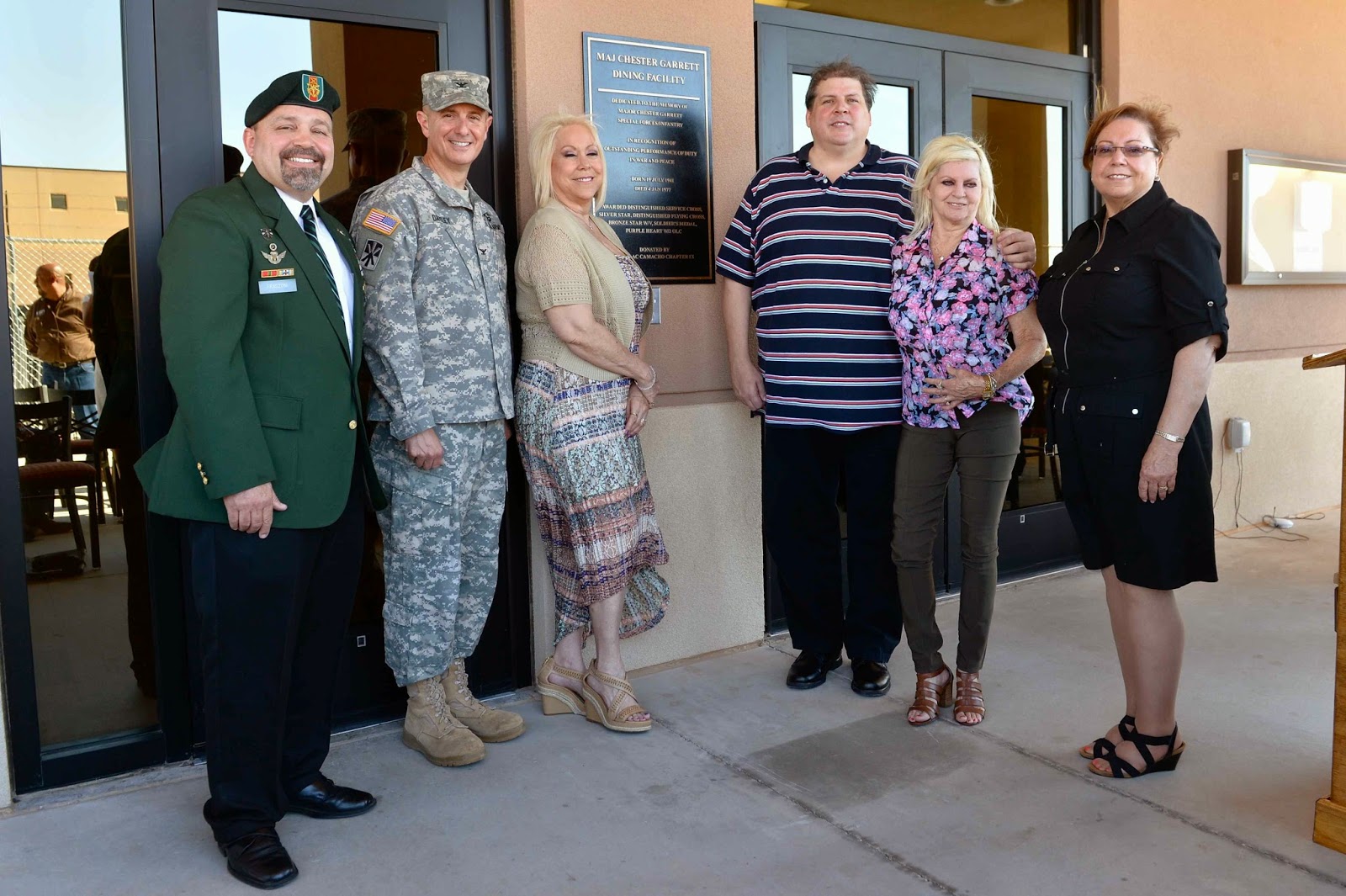
Dedication of the Major Chester Garrett Dining Facility

Photo below: SFA Chapter IX Vice-President Steve Franzoni, Fort Bliss Garrison Commander COL Dayley, Chester Garrett's three sisters and his son.
Major Garrett served in a variety of positions. His Officer assignments included: Personnel Officer, Company (Co) A, 8th Special Forces Group Airborne (SFGA), Ft Gulick, Canal Zone (CZ); Special Forces Operational Detachment–A (SFODA) Executive Officer (XO), Co A, 8th SFGA, Ft Gulick, CZ; Commander (Cdr), SFODA 341, Co A, 5th SFGA (Vietnam); Commander, Co C, 9th Battalion (Bn), 2nd Brigade (Bde) USATC, Ft Bragg, NC; Asst. XO, Headquarters 9th Bn, 2nd Basic Combat Training Bde, USATCI, Ft Bragg, NC; Intelligence Officer, 2nd Bde, 4th Infantry (Inf) Division (Div) (Vietnam); Operations Officer, 1st Bn, 12th Inf, 4th Inf Div (Vietnam); Operations Officer,2nd Bn, 5th Inf, 4th Inf Div (Vietnam); Operations Officer, 2nd Bn, 502 Inf, 101st Abn Div (Vietnam); XO 1st Bn, 501st Inf, 101st Abn Div (Vietnam); Operations Officer, 3rd Bn, 187th Inf, 101st Abn Div (Vietnam); XO, 1st Bn 5th SFGA, Cdr, Co D, 1st Bn, 5th SFGA, Ft Bragg, NC; Plans Officer, G3, US John F. Kennedy Center for Military Assistance, Ft Bragg, NC; Senior Advisor, Abn Bn, Combat Arms Training, Army Adv Gp, USMACV (Vietnam); Field Team Chief/Op Chief, JCRC USARPAC Thailand; Senior Instructor, C Battery, S&F Bn, The School Bde, US Army Air Defense School (USAADS); Bn XO, HQ Student Bn, The School Bde, USAADS, Ft Bliss, TX.
His awards and decorations include the Distinguished Service Cross, Silver Star, Distinguished Flying Cross, Soldiers Medal, Bronze Star 4th OLC w/V , Purple Heart 2nd OLC, Meritorious Service Medal, Air Medal 7th Award, Army Commendation Medal 2nd OLC w/V, Good Conduct Medal, National Defense Service Medal, Armed Forces Expeditionary Medal, Vietnam Service Medal, Vietnam Campaign Medal, Army Valorous Unit Citation, RVN Gallantry Cross with Gold Star, RVN Civil Actions Unit Citation, German Army Military Efficiency Award in Silver, RVN Parachute Badge Master Level, Combat Infantryman Badge, Expert Infantryman Badge, Master Parachutist Badge, Special Forces Tab, and Ranger tab.
Rest in Peace Major Garrett. You are not forgotten.
Thursday, March 13, 2014
Medal of Honor recipient Colonel Ola Lee Mize dies at 82
 From an article posted by Anniston-Gadsen Alabama On-line news: Medal of Honor recipient and retired Special Forces Colonel Ola Lee Mize dies at 82
Col. Ola Lee Mize, who earned the Medal of Honor for his actions during the Korean War, died today at the age of 82. Mize, a native of Marshall County and resident of Gadsden, received the medal "for conspicuous gallantry and outstanding courage above and beyond the call of duty" in September 1954 for his actions on June 10, 1953 near Outpost Harry (Surang-ni, Korea) during an intense attack.
According to his citation, Mize, then a sergeant, rescued a wounded soldier during a heavy attack, established a defensive position despite being blown down by artillery and grenade blasts three times, and inflicted heavy casualties on enemy forces. He moved between bunkers, firing at the enemy and throwing grenades. All the while, witnesses said Mize shouted encouragement to his fellows. Later during the engagement, Mize killed 10 enemy soldiers while trying to retake a machine gun position, and radioed in artillery fire before helping direct a counterattack on enemy positions.
The citation lauded Mize for "valorous conduct and unflinching courage (that) reflect lasting glory upon himself and uphold the noble traditions of the military service." Mize later served three tours in Vietnam and retired in 1981. A section of Steele Station Road in Gadsden is named in his honor, as is a veterans park and public museum dedicated last year.
Watch the video below on Colonel Mize and his recollections from the Korean War.
)
Tuesday, November 26, 2013
Five Profound Choices Special Ops Face Next Year

An article on Breaking Defense by Linda Robinson entitled - "Five Profound Choices Special Ops Face Next Year"
U.S. Special Operations Forces face decisions of profound consequence in 2014 after having been empowered by a series of policy directives taken over the past year. One of these directives has been, contrary to the caricature of unilateral commando forces popularized by video games such as Call of Duty, an unequivocal message from their command and the U.S. president: go forth and partner.
If 2013 was the year of decisions, 2014 will be the year special operations forces implement their roadmap for the future. But where exactly does that road lead? The trajectory will be determined by several budgetary and policy choices that the U.S. military, policymakers and Congress will make in 2014.
Does size matter? Special operations forces recruit most of their members from the ranks of conventional forces, a universe of personnel that is expected to shrink. It would be far better to accept a lower force level of uniformed special operators than to lower standards and keep the number at 33,000. This would maintain the existing rigorous standards to ensure that experienced, professional troops populate the elite forces. One of the key lessons of the past decade that must be enshrined for posterity is that how forces are used matters far more than their numbers.
Special operations forces can easily be frittered away in tactical and episodic missions that have no enduring or strategic value. Thoughtful application of their capabilities generally means two things: persistent presence combined with either conventional and/or multinational partners. This can mean infantry squads helping small teams of Green Berets, SEALS, and Marine special operators or Estonian, Lithuanian, Romanian and Polish special operators — to name just a few of the two dozen countries who sent SOF to Afghanistan. This footprint does not have to be thousands or tens of thousands — most often a few hundred can have an enormous impact — if they are deployed in back-to-back rotations for five to 10 years. The key here is for policymakers and U.S. ambassadors, who are the gatekeepers for U.S. forces in non-war theaters, to embrace the value of these long-term advisory missions.
Fix the commands. This year, the four-star Special Operations Command led by Adm. William McRaven assumed control of the theater special operations commands which are responsible for region-wide special operations with the intent of making them more capable. This is a vitally important part of the legacy of changes wrought by Adm. McRaven, and for it to bear the intended fruit, the theater SOF commands must be manned by the appropriate personnel and receive adequate resources in order to become world-class elite commands like the counterterrorism command. Second, for this change to be successful, the special operators must make clear at every step that they are there to serve the geographic command and ambassadorial intent. Otherwise, a new source of bureaucratic tension and infighting will be the result.
Special operators’ rhetoric and intent must become consistent and convincing that they are not trying to take over the world or behave as rogue operators. The message should be that they are part of a global defense, interagency and multinational network and behave within those constraints. Some operators fret that joining the larger defense community, which perforce means that their skills, identities and missions become known to a wider circle, will deprive them of their prized mystique. But what they lose in both warranted and unwarranted sheen of glamor they will reap many times over in increased trust and confidence.
In particular, the special operations community’s vision is not entirely clear to other partners in government. Congress held up funding for regional coordination centers and an interagency hub in Washington this spring, in part because it doubted the need for additional expenditures on what it saw as redundant structures for missions that were being performed at least in part elsewhere. Understanding and a common plan are more important than speed in these endeavors, in contrast to the urgency that undergirds many special ops undertakings.
The final and most important decision regarding special ops’ future will be the linked issues of leadership succession and institutionalization. Admiral McRaven has set in motion many initiatives that will make special operations forces a more useful and effective partner for the future, but implementation of these measures will take years beyond his tenure, whether it ends next year or the following year. It is second nature that bureaucracies resist change, and the right leader will ensure that the forward momentum continues.
Subscribe to:
Posts (Atom)