Back in May of 2015, the Havok Journal wrote about the upcoming movie Prisoner of War, a collaboration by Blackside Productions, Hand Crank Films, and the veteran charity Gallant Few. This month marks a year since the movie was officially released.
Several big names in the veteran community were involved in this film both in front of and behind the camera, giving it the kind of credibility and authenticity that most military-themed movies lack. The 13-minute production stars former Ranger Josh Kelly, who gives an astonishing and completely believable performance as a veteran dealing with self-doubt, survivor’s guilt, and PTSD; issues very familiar to many within the veteran community. Actually, Josh Kelly gives two great performances in this film, but you have to be looking for the second role.
The veteran involvement in Prisoner of War extended behind the camera as well. Director Matt Sanders and producer Marty Skovlund were both Army Rangers, and the musical score was provided by Air Force TACP Jarred Taylor. Many of the other actors and film crew were vets as well. At the end of the movie, Gallant Few’s Karl Monger, himself a former Ranger, delivers a heartfelt public service announcement.
So what is “Prisoner of War?” It’s neither fiction nor documentary; it’s something in between, something that has to be experienced more than simply watched. his movie is disturbing. It’s dark. It’s raw. It’s going to “trigger” the hell out of people. And it is an absolute “must-watch” for veterans and those who care about veterans’ issues, especially PTSD and veteran suicide.
If you care about veterans or issues that are important to veterans, watch this movie. If you don’t get the “plot twist” towards the end of the film, watch it again.
You don’t have to be a veteran to “get” Prisoner of War. You don’t have to be a veteran to relate to Josh Kelly’s unnamed character in the movie. While the issues addressed in the movie are presented through the experiences of one combat veteran, they are certainly not unique to the veteran community. That “relatability,” and the raw, non-judgmental honesty with which the movie is presented, make it a must-watch for everyone who has ever struggled with guilt, shame, or self-doubt… which, is everyone really.
Article from the Havok Journal
Showing posts with label PTSD. Show all posts
Saturday, December 7, 2019
Sunday, November 24, 2019
Military Suicide Myths
Over the last five years the suicide rate among active duty American military personnel has been rising, even though there has been a lot less combat duty. Most American troops withdrew from Iraq in 2011 and Afghanistan in 2014. This suicide increase is apparently from the stress of being overseas, not in combat as well as just being in the peacetime military.
In 2013 suicides for the 520,000 active duty U.S. Army personnel declined from 35.6 to 29 per 100,000 personnel. At that time the suicides for the entire military were down 16 percent. The navy experienced the sharpest drop (25 percent). In 2013, after more than a decade of heavy combat the military knew that these fluctuating suicide rates had little to do with combat. This is being demonstrated now because the suicide has been rising at about six percent a year since 2014.
So has the rate among civilians. Current rates are 30 per 100,000 for the army, 31 for the marines, 20 for the navy and 18 for the air force. The rate is higher in some job categories that are particularly stressful. Thus SOCOM (Special Operations Command), which has paid particular attention to reducing suicides, with hit a high of 33 per 100,000 in 2012. That was reduced to 18 by 2014 and was down to 8 per 100,000 personnel in 2017. Suddenly it went up to 22 in 2018. SOCOM only has 70,000 personnel so a few suicides a year can shift the rate dramatically. But going from 8 to 22 in one year is extraordinary. Then again so was reducing the rate from 33 to 18 in two years. SOCOM is a special case in several ways. For one thing about a third of its personnel are combat troops and they have been spending a lot of time overseas since 2014 because of ISIL (Islamic State in Iraq and the Levant) and the fact that while fewer troops are fighting in Iraq and Afghanistan there are still plenty of Islamic terrorists to deal with and that is done largely using SOCOM personnel.
Commanders have long warned that year after year of overseas deployments for SOCOM operators (the combat specialists) takes its toll, even on this carefully selected (for the ability to handle stress) and trained group of specialists. There have also been problems with some special operations commanders, who have made mistakes while trying to keep their men combat capable. As long predicted this intense use of SOCOM personnel since 2001 has made suicide, morale and readiness problems worse. That said, SOCOM is a small part of the American military, comprising about five percent of active duty personnel. The vast majority of military personnel, and suicides, are non-combat troops.
Military epidemiologists (experts on medical statistics) have long sought to convince people outside the military that the rise in suicide rates within the military has little to do with the stress of combat and mostly to do with the stresses of military life during wartime or peacetime. In other words, the increased suicides were not concentrated among the combat veterans, who make up less than 15 percent of those in the military, but are more evenly distributed among all service personnel. For example during the last decade over 75 percent of suicides were among troops who had never gone overseas.
The military, especially the army, has long documented all deaths and the Department of Defense in 2013 released a study of all suicides since 2001, when more troops saw combat, to 2008, when the heavy fighting in Iraq ended. A similar study for 2009-2012 suicides found little change. The researchers also point out that the reasons for suicides in the military are quite similar to those for civilian suicides, especially when victims are of the same age, education, and other factors as their military counterparts. In other words periods of intense combat for the military have little impact on the overall suicide rate because so few troops are exposed to combat.
These revelations were not well received by the mass media which makes much of the rising suicide rate in military but pays less attention to rising suicide rates among civilians of the same age and education. That was 9 per 100,000 in 2001 but had risen to 17.5 in 2013 and by 2016 was 26 per 100,000 men aged 25-44, which is the age of most men in the military. This was declared to be a health emergency, and to a certain degree it was. What was missed in all the discussion was that the higher suicide rate in the military is usually below the rate for civilians of military age.
The fact of the matter is that the military seeks to recruit only people who have an above average ability to deal with stress, especially for the minority headed for combat jobs. It’s not just combat stress the military worries about, because so few troops in the ground forces have combat jobs. The rest are doing civilian type jobs but often under stressful (combat zone) conditions. In fact, most of the military suicides are of men who were never in combat or even overseas. But since the military suicide rate is so much lower than those of comparable civilians, it hardly matters. There are so few actual suicides in the military each year that a few soldiers having family problems can cause the rate to seemingly spike. That’s largely what has been happening. The question now is what factors have caused the rate to creep up steadily since 2014.
The military has been doing a lot to keep their suicide rate down. That rate peaked at 23 in 2009, and then declined. Some of the increase was from the impact of so many troops suffering from PTSD (post-traumatic stress disorder), but the recent studies of that show this was a small factor in suicides. The danger of suicide led to many PTSD sufferers, or those who might have it, to be given anti-stress medications. Use of these medicines increased 76 percent between 2001 and 2009. By then, some 17 percent of all troops took these drugs, including six percent of those in combat zones. In 2001, the troops used these drugs to about the same degree as the civilian population (ten percent).
The losses to stress for troops overseas have been growing since 2003. For example, for every soldier killed in a combat zone, one was sent back home for treatment of acute stress. Most of these are not combat troops. For every one of those cases there are several less serious ones that are treated in the combat zone. Many of these stressed troops are no longer able to perform all their duties. This is sometimes the case with troops taking anti-stress drugs. Some of these medications slow you down, which can be fatal if you find yourself in combat or an emergency situation. Many troops on these medications are no longer sent overseas. They can perform well back in the United States but this complicates the job of finding enough troops to go perform combat jobs.
Problems with stress and mental health in general were seen as an inevitable result of so many NCOs and officers doing their third or fourth combat tours (in Iraq or Afghanistan). Thus, a PTSD epidemic has been created by the unprecedented exposure of so many troops to so much combat in so short a time. Once a soldier has PTSD they are often no longer fit for combat, and many troops headed for Afghanistan after 2008 fell into this category. PTSD makes it difficult for people to function or get along with others. With treatment (medication and therapy) you can recover from PTSD. But this can take months or years.
Nearly a century of energetic effort to diagnose and treat PTSD, including much recent attention to civilian victims stressed via accidents or criminal assault, made it clear that most troops eventually got PTSD if they were in combat long enough. During World War II it was found that, on average, 200 days of combat would bring on a case of PTSD for your average American soldier. After World War II methods were developed to delay the onset of PTSD. These included more breaks from combat, better living conditions in the combat zone and prompt treatment when PTSD was detected. That's why combat troops in Iraq and Afghanistan often slept in air conditioned quarters, had Internet access, a lot of amenities, and a two week vacation (anywhere) in the middle of their combat tour. This extended their useful time in combat before PTSD set in. No one is yet sure what the new combat days average is, and new screening methods are an attempt to find out. But more troops appear to be hitting, or approaching, the limits.
What the army did know by 2011 was that a large percentage of its combat troops serving in Iraq and Afghanistan have had over 200 days of combat. Some have three or four times that. A major reason for army generals talking (starting in 2007) about the army "needing a break" (from combat) was the growing loss of many combat experienced troops and leaders (especially NCOs) to PTSD. The army won't give out exact figures, partly because they don't have much in the way of exact figures. But over the next decade, the army will get a clearer picture of how well they have coped with PTSD among troops who have, individually, seen far more combat than their predecessors in Vietnam, Korea, or World War II.
The army is dealing with PTSD and combat stress head on, believing that a lot of troops have experienced an unhealthy amount of combat stress. Experience so far has shown that PTSD can be delayed, perhaps for a long time. When a soldier does come down with it, PTSD can often be treated and its effects reversed. This has large ramifications for non-military medicine, for many civilians suffer from PTSD. That's why military recruits are screened for their ability to handle stress and resist PTSD. In the civilian community, there are far more people who can acquire PTSD after exposure to much less stress.
Article from the Strategy Page
In 2013 suicides for the 520,000 active duty U.S. Army personnel declined from 35.6 to 29 per 100,000 personnel. At that time the suicides for the entire military were down 16 percent. The navy experienced the sharpest drop (25 percent). In 2013, after more than a decade of heavy combat the military knew that these fluctuating suicide rates had little to do with combat. This is being demonstrated now because the suicide has been rising at about six percent a year since 2014.
So has the rate among civilians. Current rates are 30 per 100,000 for the army, 31 for the marines, 20 for the navy and 18 for the air force. The rate is higher in some job categories that are particularly stressful. Thus SOCOM (Special Operations Command), which has paid particular attention to reducing suicides, with hit a high of 33 per 100,000 in 2012. That was reduced to 18 by 2014 and was down to 8 per 100,000 personnel in 2017. Suddenly it went up to 22 in 2018. SOCOM only has 70,000 personnel so a few suicides a year can shift the rate dramatically. But going from 8 to 22 in one year is extraordinary. Then again so was reducing the rate from 33 to 18 in two years. SOCOM is a special case in several ways. For one thing about a third of its personnel are combat troops and they have been spending a lot of time overseas since 2014 because of ISIL (Islamic State in Iraq and the Levant) and the fact that while fewer troops are fighting in Iraq and Afghanistan there are still plenty of Islamic terrorists to deal with and that is done largely using SOCOM personnel.
Commanders have long warned that year after year of overseas deployments for SOCOM operators (the combat specialists) takes its toll, even on this carefully selected (for the ability to handle stress) and trained group of specialists. There have also been problems with some special operations commanders, who have made mistakes while trying to keep their men combat capable. As long predicted this intense use of SOCOM personnel since 2001 has made suicide, morale and readiness problems worse. That said, SOCOM is a small part of the American military, comprising about five percent of active duty personnel. The vast majority of military personnel, and suicides, are non-combat troops.
Military epidemiologists (experts on medical statistics) have long sought to convince people outside the military that the rise in suicide rates within the military has little to do with the stress of combat and mostly to do with the stresses of military life during wartime or peacetime. In other words, the increased suicides were not concentrated among the combat veterans, who make up less than 15 percent of those in the military, but are more evenly distributed among all service personnel. For example during the last decade over 75 percent of suicides were among troops who had never gone overseas.
The military, especially the army, has long documented all deaths and the Department of Defense in 2013 released a study of all suicides since 2001, when more troops saw combat, to 2008, when the heavy fighting in Iraq ended. A similar study for 2009-2012 suicides found little change. The researchers also point out that the reasons for suicides in the military are quite similar to those for civilian suicides, especially when victims are of the same age, education, and other factors as their military counterparts. In other words periods of intense combat for the military have little impact on the overall suicide rate because so few troops are exposed to combat.
These revelations were not well received by the mass media which makes much of the rising suicide rate in military but pays less attention to rising suicide rates among civilians of the same age and education. That was 9 per 100,000 in 2001 but had risen to 17.5 in 2013 and by 2016 was 26 per 100,000 men aged 25-44, which is the age of most men in the military. This was declared to be a health emergency, and to a certain degree it was. What was missed in all the discussion was that the higher suicide rate in the military is usually below the rate for civilians of military age.
The fact of the matter is that the military seeks to recruit only people who have an above average ability to deal with stress, especially for the minority headed for combat jobs. It’s not just combat stress the military worries about, because so few troops in the ground forces have combat jobs. The rest are doing civilian type jobs but often under stressful (combat zone) conditions. In fact, most of the military suicides are of men who were never in combat or even overseas. But since the military suicide rate is so much lower than those of comparable civilians, it hardly matters. There are so few actual suicides in the military each year that a few soldiers having family problems can cause the rate to seemingly spike. That’s largely what has been happening. The question now is what factors have caused the rate to creep up steadily since 2014.
The military has been doing a lot to keep their suicide rate down. That rate peaked at 23 in 2009, and then declined. Some of the increase was from the impact of so many troops suffering from PTSD (post-traumatic stress disorder), but the recent studies of that show this was a small factor in suicides. The danger of suicide led to many PTSD sufferers, or those who might have it, to be given anti-stress medications. Use of these medicines increased 76 percent between 2001 and 2009. By then, some 17 percent of all troops took these drugs, including six percent of those in combat zones. In 2001, the troops used these drugs to about the same degree as the civilian population (ten percent).
The losses to stress for troops overseas have been growing since 2003. For example, for every soldier killed in a combat zone, one was sent back home for treatment of acute stress. Most of these are not combat troops. For every one of those cases there are several less serious ones that are treated in the combat zone. Many of these stressed troops are no longer able to perform all their duties. This is sometimes the case with troops taking anti-stress drugs. Some of these medications slow you down, which can be fatal if you find yourself in combat or an emergency situation. Many troops on these medications are no longer sent overseas. They can perform well back in the United States but this complicates the job of finding enough troops to go perform combat jobs.
Problems with stress and mental health in general were seen as an inevitable result of so many NCOs and officers doing their third or fourth combat tours (in Iraq or Afghanistan). Thus, a PTSD epidemic has been created by the unprecedented exposure of so many troops to so much combat in so short a time. Once a soldier has PTSD they are often no longer fit for combat, and many troops headed for Afghanistan after 2008 fell into this category. PTSD makes it difficult for people to function or get along with others. With treatment (medication and therapy) you can recover from PTSD. But this can take months or years.
Nearly a century of energetic effort to diagnose and treat PTSD, including much recent attention to civilian victims stressed via accidents or criminal assault, made it clear that most troops eventually got PTSD if they were in combat long enough. During World War II it was found that, on average, 200 days of combat would bring on a case of PTSD for your average American soldier. After World War II methods were developed to delay the onset of PTSD. These included more breaks from combat, better living conditions in the combat zone and prompt treatment when PTSD was detected. That's why combat troops in Iraq and Afghanistan often slept in air conditioned quarters, had Internet access, a lot of amenities, and a two week vacation (anywhere) in the middle of their combat tour. This extended their useful time in combat before PTSD set in. No one is yet sure what the new combat days average is, and new screening methods are an attempt to find out. But more troops appear to be hitting, or approaching, the limits.
What the army did know by 2011 was that a large percentage of its combat troops serving in Iraq and Afghanistan have had over 200 days of combat. Some have three or four times that. A major reason for army generals talking (starting in 2007) about the army "needing a break" (from combat) was the growing loss of many combat experienced troops and leaders (especially NCOs) to PTSD. The army won't give out exact figures, partly because they don't have much in the way of exact figures. But over the next decade, the army will get a clearer picture of how well they have coped with PTSD among troops who have, individually, seen far more combat than their predecessors in Vietnam, Korea, or World War II.
The army is dealing with PTSD and combat stress head on, believing that a lot of troops have experienced an unhealthy amount of combat stress. Experience so far has shown that PTSD can be delayed, perhaps for a long time. When a soldier does come down with it, PTSD can often be treated and its effects reversed. This has large ramifications for non-military medicine, for many civilians suffer from PTSD. That's why military recruits are screened for their ability to handle stress and resist PTSD. In the civilian community, there are far more people who can acquire PTSD after exposure to much less stress.
Article from the Strategy Page
Labels:
invisible wounds,
Military Suicide Myths,
PTSD,
silent wounds
Friday, June 8, 2018
Battling Depression And Suicide Among Female Veterans
The suicide rate for female veterans has soared 85 percent in recent years, leading the military, VA and advocacy groups to try new ways to improve women's mental health care during and after service. One key focus: how to tailor the sometimes tricky jump from the military to the civilian world.
Women's experiences in the military are different from men's, so their transition needs to be different, too, said retired Army Col. Ellen Haring, director of research for the advocacy group Service Women's Action Network (SWAN). "The experiences you have on active duty carry with you, and then they manifest as mental wellness challenges as veterans," she said. "When you're transitioning out of the service, or when you return from a combat deployment to come back to a stateside demobilization and try to return to family or community, that's a challenging period."
When that transition doesn't go well, the cost can be terrible. Female veterans are nearly 250 percent more likely to kill themselves than civilian women. While male veterans also are more likely than their civilian counterparts to commit suicide, their rate is 18 percent higher.
When Deana came back, something had changed
Deana Martorella Orellana, who for much of her career as a Marine was stationed at Camp Lejeune, N.C., is among those who couldn't make the transition to civilian life work. "She was beautiful, a smart kid, really smart," said her mother, Laurel Martorella, of Arnold, Md.
And Deana was something more than that. She was a junior high soccer whiz who made the boys on the field seem frozen in place. She was so athletic, say those who knew her, that watching one of Deana's games then, or later in high school or college, could make you just stop and savor the sheer wonder of human potential. "She really excelled at anything she tried," said her mother.
And eventually, she tried the Marines. Her mother said Deana beat everyone - male or female - on the physical tests at boot camp. Then, in 2010, she deployed to a particularly combat-torn part of Helmand Province in Afghanistan. There, Deana was assigned to a small female team that was attached to a male infantry unit. The team worked with the Afghan women and children they encountered.
When Deana came back, something had changed, said her family. One of Deana's siblings, Robin Jewell, said the problem had to do with something Deana saw or experienced involving Afghan children, but Deana never opened up about the details. "She said that she didn't see things the same, and she could handle everything except for the kids," Jewell said. "And I don't know what that means. She just didn't talk."
After she returned to North Carolina in 2013, her rental home burned down, and a man she knew was charged with arson. She wasn't home, but the incident shook her. She loved being a Marine - she had the Corps' eagle, globe and anchor insignia tattooed nearly the size of a basketball on one flank - but decided to leave the service in 2015 when her enlistment ended. She stayed close to Camp Lejeune, tending bar and working as a personal trainer. She was planning to earn a college degree in exercise science.
But problems piled up. Deana moved out of her boyfriend's home, said her mother. She was charged with driving drunk. Then she was charged again. She was reaching a tipping point. "Deana was very much a perfectionist," said Jewell, "and I think that in her eyes this was a huge failure."
On March 4th, 2016, Deana went to the VA for help, her mother said. VA officials later told the family that Deana agreed to counseling. But just hours after the VA appointment, Deana asked a friend to drop her at the house where she had lived with her boyfriend, who wasn't home. She went in the bedroom and retrieved a .45-caliber handgun. She sat on the floor and leaned against a wall. That's how her body was found.
"She wrote a note," said her mother, sitting at Jewell's kitchen table in Maryland. "But not a real note," Jewell added. "Not a Dear John." Her mother recalled what it said: "I'm sorry, call 911, take care of the dog, don't come in the bedroom."
Medical examiners' reports have a line listing valuables found with a body. Deana was wearing a fitness band and a plastic bracelet. In her pocket was a sheaf of handwritten inspirational quotes. Words, as they say, to live by.
She had been out of the Marines only a few months. VA has recently received data showing that a startlingly high number of suicides come in the first days, weeks and months after veterans leave the military, and mental health experts there say they're looking at how to use that data to improve the chances of making things go right for freshly-minted veterans.
A VA official later told her family that Deana had PTSD related to combat — which she had never even told them that she had experienced — and from the house fire. Somehow in moving from regimented military life back into the civilian world, Deana hadn't connected with someone who could keep her from feeling like her PTSD and other problems were piling too high.
Additional stresses for female troops
Deana's family doesn't blame the VA or military. They just think if the process had been better ... different somehow ... maybe Deana would have sought help earlier. "The soldiers themselves don't fully understand to say, 'I need the help,' " Jewell said. "Military members aren't taught to be able to ask for help when it's time, and therefore the VA system is unable to learn how to provide said help because neither side is connecting."
Ellen Haring, the research expert with SWAN, has studied the effects of serving in the tiny women's teams in combat zones like Deana did. Haring isn't familiar with Deana's specific case, but says the role creates stresses beyond the obvious ones of combat. Women may be pulled from the support networks in their own units and sent to locations where they see heavy fighting.
Often, even back on base between missions, while the men are decompressing, the women may feel like they can't let down their guard because of the possibility of sexual assault. "So they return to units that didn't know where they had been," Haring said. "They didn't have the same kind of bonding opportunities with the people that they had served with."
A need for human connections
SWAN has just released a half dozen recommendations on the mental health needs of women service members and veterans. They were based on a poll that gauged the mental health needs of veterans and women on active duty. A key recommendation is to establish stronger social support groups and networks for military women.
Air Force veteran Cat Corchado has already helped do that in Charlotte, N.C. She helps lead local meetings of a new network called Women Veteran Network, or WoVeN. The meetings are only for female veterans, and they've started in a host of locations around the country over the past few weeks, thanks to a grant from the Walmart Foundation and with support from the VA. The idea is to build connections and community among women veterans.
Human connections are crucial for mental health, and especially when women are just getting out of the service, said Corchado. "The military really made it seem like all you do is this, this and this, and you need LinkedIn and you'll be good," said Corchado, who's a personal trainer and real estate agent.
Once out of the service, though, she didn't feel tied in to any kind of support. "You get into this free fall and you don't know how to climb back out of it," Corchado said. "But I didn't realize until years later that every veteran, but especially female veterans go through that free fall."
The VA says it has a host of suicide prevention efforts underway, including a system that harnesses the power of big data to identify veterans at particular risk. It analyzes more than 60 characteristics, including gender, age, geographic location, drug prescriptions and medical history. The VA can check in with veterans whom the system flags.
The agency also has been trying to train veterans and their families about gun safety, said Megan McCarthy, the VA's deputy director for suicide protection. "One of the reasons we think why women veterans die by suicide at higher rates than civilians do is because they are more likely to attempt suicide with a firearm than civilian women," McCarthy said. "Firearms are a very lethal method of suicide."
Data show that women who get VA care are less likely to kill themselves. But of the 20 or so male and female veterans a day who do commit suicide, about 14 aren't in the VA's care. "We are really working hard to try to understand more about those 14 veterans who die by suicide each day who aren't in VA healthcare and make sure they have the good care and support that they have earned," McCarthy said.
More information from the VA about suicide prevention and mental health, including crisis contacts, can be found at:
www.mentalhealth.va.gov/suicide_prevention/
All of SWAN's recommendations for improving mental healthcare for military women can be found at:
https://www.servicewomen.org/wp-content/uploads/2018/02/2018-Annual-Summit-Report-Final.compressed.pdf
More information on Deana's foundation is at:
https://en-gb.facebook.com/DeanaMartorellaMemorialScholarship/
Article from NPR
Women's experiences in the military are different from men's, so their transition needs to be different, too, said retired Army Col. Ellen Haring, director of research for the advocacy group Service Women's Action Network (SWAN). "The experiences you have on active duty carry with you, and then they manifest as mental wellness challenges as veterans," she said. "When you're transitioning out of the service, or when you return from a combat deployment to come back to a stateside demobilization and try to return to family or community, that's a challenging period."
When that transition doesn't go well, the cost can be terrible. Female veterans are nearly 250 percent more likely to kill themselves than civilian women. While male veterans also are more likely than their civilian counterparts to commit suicide, their rate is 18 percent higher.
When Deana came back, something had changed
Deana Martorella Orellana, who for much of her career as a Marine was stationed at Camp Lejeune, N.C., is among those who couldn't make the transition to civilian life work. "She was beautiful, a smart kid, really smart," said her mother, Laurel Martorella, of Arnold, Md.
And Deana was something more than that. She was a junior high soccer whiz who made the boys on the field seem frozen in place. She was so athletic, say those who knew her, that watching one of Deana's games then, or later in high school or college, could make you just stop and savor the sheer wonder of human potential. "She really excelled at anything she tried," said her mother.
And eventually, she tried the Marines. Her mother said Deana beat everyone - male or female - on the physical tests at boot camp. Then, in 2010, she deployed to a particularly combat-torn part of Helmand Province in Afghanistan. There, Deana was assigned to a small female team that was attached to a male infantry unit. The team worked with the Afghan women and children they encountered.
When Deana came back, something had changed, said her family. One of Deana's siblings, Robin Jewell, said the problem had to do with something Deana saw or experienced involving Afghan children, but Deana never opened up about the details. "She said that she didn't see things the same, and she could handle everything except for the kids," Jewell said. "And I don't know what that means. She just didn't talk."
After she returned to North Carolina in 2013, her rental home burned down, and a man she knew was charged with arson. She wasn't home, but the incident shook her. She loved being a Marine - she had the Corps' eagle, globe and anchor insignia tattooed nearly the size of a basketball on one flank - but decided to leave the service in 2015 when her enlistment ended. She stayed close to Camp Lejeune, tending bar and working as a personal trainer. She was planning to earn a college degree in exercise science.
But problems piled up. Deana moved out of her boyfriend's home, said her mother. She was charged with driving drunk. Then she was charged again. She was reaching a tipping point. "Deana was very much a perfectionist," said Jewell, "and I think that in her eyes this was a huge failure."
On March 4th, 2016, Deana went to the VA for help, her mother said. VA officials later told the family that Deana agreed to counseling. But just hours after the VA appointment, Deana asked a friend to drop her at the house where she had lived with her boyfriend, who wasn't home. She went in the bedroom and retrieved a .45-caliber handgun. She sat on the floor and leaned against a wall. That's how her body was found.
"She wrote a note," said her mother, sitting at Jewell's kitchen table in Maryland. "But not a real note," Jewell added. "Not a Dear John." Her mother recalled what it said: "I'm sorry, call 911, take care of the dog, don't come in the bedroom."
Medical examiners' reports have a line listing valuables found with a body. Deana was wearing a fitness band and a plastic bracelet. In her pocket was a sheaf of handwritten inspirational quotes. Words, as they say, to live by.
She had been out of the Marines only a few months. VA has recently received data showing that a startlingly high number of suicides come in the first days, weeks and months after veterans leave the military, and mental health experts there say they're looking at how to use that data to improve the chances of making things go right for freshly-minted veterans.
A VA official later told her family that Deana had PTSD related to combat — which she had never even told them that she had experienced — and from the house fire. Somehow in moving from regimented military life back into the civilian world, Deana hadn't connected with someone who could keep her from feeling like her PTSD and other problems were piling too high.
Additional stresses for female troops
Deana's family doesn't blame the VA or military. They just think if the process had been better ... different somehow ... maybe Deana would have sought help earlier. "The soldiers themselves don't fully understand to say, 'I need the help,' " Jewell said. "Military members aren't taught to be able to ask for help when it's time, and therefore the VA system is unable to learn how to provide said help because neither side is connecting."
Ellen Haring, the research expert with SWAN, has studied the effects of serving in the tiny women's teams in combat zones like Deana did. Haring isn't familiar with Deana's specific case, but says the role creates stresses beyond the obvious ones of combat. Women may be pulled from the support networks in their own units and sent to locations where they see heavy fighting.
Often, even back on base between missions, while the men are decompressing, the women may feel like they can't let down their guard because of the possibility of sexual assault. "So they return to units that didn't know where they had been," Haring said. "They didn't have the same kind of bonding opportunities with the people that they had served with."
A need for human connections
SWAN has just released a half dozen recommendations on the mental health needs of women service members and veterans. They were based on a poll that gauged the mental health needs of veterans and women on active duty. A key recommendation is to establish stronger social support groups and networks for military women.
Air Force veteran Cat Corchado has already helped do that in Charlotte, N.C. She helps lead local meetings of a new network called Women Veteran Network, or WoVeN. The meetings are only for female veterans, and they've started in a host of locations around the country over the past few weeks, thanks to a grant from the Walmart Foundation and with support from the VA. The idea is to build connections and community among women veterans.
Human connections are crucial for mental health, and especially when women are just getting out of the service, said Corchado. "The military really made it seem like all you do is this, this and this, and you need LinkedIn and you'll be good," said Corchado, who's a personal trainer and real estate agent.
Once out of the service, though, she didn't feel tied in to any kind of support. "You get into this free fall and you don't know how to climb back out of it," Corchado said. "But I didn't realize until years later that every veteran, but especially female veterans go through that free fall."
The VA says it has a host of suicide prevention efforts underway, including a system that harnesses the power of big data to identify veterans at particular risk. It analyzes more than 60 characteristics, including gender, age, geographic location, drug prescriptions and medical history. The VA can check in with veterans whom the system flags.
The agency also has been trying to train veterans and their families about gun safety, said Megan McCarthy, the VA's deputy director for suicide protection. "One of the reasons we think why women veterans die by suicide at higher rates than civilians do is because they are more likely to attempt suicide with a firearm than civilian women," McCarthy said. "Firearms are a very lethal method of suicide."
Data show that women who get VA care are less likely to kill themselves. But of the 20 or so male and female veterans a day who do commit suicide, about 14 aren't in the VA's care. "We are really working hard to try to understand more about those 14 veterans who die by suicide each day who aren't in VA healthcare and make sure they have the good care and support that they have earned," McCarthy said.
More information from the VA about suicide prevention and mental health, including crisis contacts, can be found at:
www.mentalhealth.va.gov/suicide_prevention/
All of SWAN's recommendations for improving mental healthcare for military women can be found at:
https://www.servicewomen.org/wp-content/uploads/2018/02/2018-Annual-Summit-Report-Final.compressed.pdf
More information on Deana's foundation is at:
https://en-gb.facebook.com/DeanaMartorellaMemorialScholarship/
Article from NPR
Friday, May 1, 2015
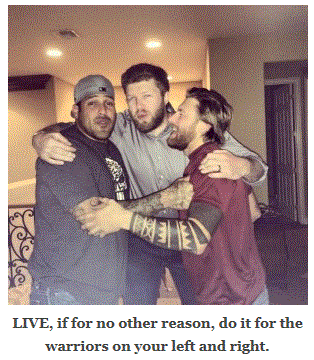
“100% And Then Some:” Live, For The Warriors On Your Left And Right
This article was previously published in the Havoc Journal by Vince “Rocco” Vargas who is a former US Army Ranger and combat veteran, and is currently the Chief Operations Officer of Article 15 Clothing.
“100% And Then Some:” Live, For The Warriors On Your Left And Right
May 1, 2015 by Vincent Vargas
Never shall I fail my comrades. I will always keep myself mentally alert, physically strong, and morally straight, and I will shoulder more than my share of the task, whatever it may be, one hundred percent and then some. -3rd Stanza of The Ranger Creed
This might not be what anybody wants to hear, but it is something I have to say. I’m not saying this because I feel I am above this plague, but because I owe it to my brothers and sisters to speak my true feelings on the matter.
Instead of concentrating on the 22 veterans a day who commit suicide, our attention should be focused on a new mission. Why do we continue to highlight suicide? We can’t continue to feel victimized because the VA doesn’t have the answers. Have we not realized the issue gets worse the more we spotlight it? It’s given some individuals a terrible direction when they felt cornered, “I am feeling down… well, might as well kill myself since everyone else does it.” We give them the satisfaction of being a statistic.
Let’s remove the word “suicide” from our vocabulary. Our attention should be focused on a new mission: the warriors we have to our left and right. Let’s find a positive way to handle this; the last thing we need to do is continue to make it a path that is taken when guys get down. When you come to a road block, you find another way or you punch through it, you don’t just keep running into it. Simply put, the current strategy is failing us. PTSD is a legitimate issue that needs to be addressed, but not the way our community has decided to do it. Our epidemic is that we are told being a victim is acceptable. Well, sorry to tell you, but it’s not.
Do what you did in the military when things got hard: take a knee, face out and drink water. Stop, take a deep breath, evaluate your situation, and complete this mission called life. You don’t quit. You never quit. In uniform you didn’t have the option to quit, and if you did your squad leader kicked your ass. So don’t quit on us now. Ranger Up said it best: IT’S SELFISH! Some even say it’s cowardly. Don’t do it.
Part of this failing strategy can be blamed on a new group of assholes who cry wolf; they are clogging the airwaves and pulling focus away from the folks who need it. We are so sensitive to losing our brothers and sisters that now we have a knee jerk reaction to lend a hand only to find out they are just seeking attention. There is a special place for those assholes, who take advantage of our vigilance for their own narcissistic pleasure. They know we answer the call to arms, so now we become the fools. I’m tired of it.
At the same time, some of these people are on the brink and they don’t reach out because they don’t want to be put in the position of somebody thinking they cried wolf because they were talked out of it. I feel this dynamic is largely to blame for the failing anti-suicide movement. Take a look at the high speed studs who found a way to keep their demons behind them by always placing one foot in front of the other: Article 15 Clothing CEO Mat Best, Ranger Up CEO Nick Palmisano, UFC fighter Tim Kennedy, Blackside Concepts owner Marty Skovlund, author and fitness expert Leo Jenkins, Article 15’s CMO Jarred Taylor, and Straight Legless clothing founder Derek Wieda, among others.
These are all house hold names in our community now. I could easily name many more, but these are the guys who are in our faces every day. Not coincidentally, they are also some of the most combat experienced individuals you will ever meet. If you ask them, I can guarantee they won’t say it, but I know them personally and know they have had their battles too, but they don’t play the victim, they don’t lie down. These men are no different than you or I. They are just human beings pushing forward.
They maintain the same motivation and drive they had in the military. They have a mission and they complete it. Once that one is completed, they make a new mission. They drink and laugh, work hard and GRIND! This is nothing different then what they did in the service. This isn’t going to sit well with a lot of you. I know that and I don’t give a shit. I want this suicide epidemic to stop just like the rest of you. There is definitely a better way. Let’s laugh, let’s have a few drinks, lets hangout and just be together. Let’s do what we did in our units. There is a community of military individuals ready to hang out and do the same. You just have to reach out.
There are some hotlines and counselors out there that do great work. I am not saying don’t go get help. Just the opposite, if you need it go get it. It’s just like sick call: go get your help, but if you are looking for someone to hold your hand and walk to you the counselor, you are highly mistaken. Ultimately, you are responsible for your own health, so don’t expect anything different. There are no simple answers, all we can do is recognize what is and is not working. Let’s work together to remove the focus of suicide and bring back the idea of community and brotherhood.
If you willingly choose to be that statistic, then you have chosen to fail your comrades. Remember all those times when guys quit all around you in basic or selection? Keep that same mentality. Never Quit. Don’t fail yourself, and don’t fail us. One hundred percent, and then some.
“100% And Then Some:” Live, For The Warriors On Your Left And Right
May 1, 2015 by Vincent Vargas
Never shall I fail my comrades. I will always keep myself mentally alert, physically strong, and morally straight, and I will shoulder more than my share of the task, whatever it may be, one hundred percent and then some. -3rd Stanza of The Ranger Creed
This might not be what anybody wants to hear, but it is something I have to say. I’m not saying this because I feel I am above this plague, but because I owe it to my brothers and sisters to speak my true feelings on the matter.
Instead of concentrating on the 22 veterans a day who commit suicide, our attention should be focused on a new mission. Why do we continue to highlight suicide? We can’t continue to feel victimized because the VA doesn’t have the answers. Have we not realized the issue gets worse the more we spotlight it? It’s given some individuals a terrible direction when they felt cornered, “I am feeling down… well, might as well kill myself since everyone else does it.” We give them the satisfaction of being a statistic.
Let’s remove the word “suicide” from our vocabulary. Our attention should be focused on a new mission: the warriors we have to our left and right. Let’s find a positive way to handle this; the last thing we need to do is continue to make it a path that is taken when guys get down. When you come to a road block, you find another way or you punch through it, you don’t just keep running into it. Simply put, the current strategy is failing us. PTSD is a legitimate issue that needs to be addressed, but not the way our community has decided to do it. Our epidemic is that we are told being a victim is acceptable. Well, sorry to tell you, but it’s not.
Do what you did in the military when things got hard: take a knee, face out and drink water. Stop, take a deep breath, evaluate your situation, and complete this mission called life. You don’t quit. You never quit. In uniform you didn’t have the option to quit, and if you did your squad leader kicked your ass. So don’t quit on us now. Ranger Up said it best: IT’S SELFISH! Some even say it’s cowardly. Don’t do it.
Part of this failing strategy can be blamed on a new group of assholes who cry wolf; they are clogging the airwaves and pulling focus away from the folks who need it. We are so sensitive to losing our brothers and sisters that now we have a knee jerk reaction to lend a hand only to find out they are just seeking attention. There is a special place for those assholes, who take advantage of our vigilance for their own narcissistic pleasure. They know we answer the call to arms, so now we become the fools. I’m tired of it.
At the same time, some of these people are on the brink and they don’t reach out because they don’t want to be put in the position of somebody thinking they cried wolf because they were talked out of it. I feel this dynamic is largely to blame for the failing anti-suicide movement. Take a look at the high speed studs who found a way to keep their demons behind them by always placing one foot in front of the other: Article 15 Clothing CEO Mat Best, Ranger Up CEO Nick Palmisano, UFC fighter Tim Kennedy, Blackside Concepts owner Marty Skovlund, author and fitness expert Leo Jenkins, Article 15’s CMO Jarred Taylor, and Straight Legless clothing founder Derek Wieda, among others.
These are all house hold names in our community now. I could easily name many more, but these are the guys who are in our faces every day. Not coincidentally, they are also some of the most combat experienced individuals you will ever meet. If you ask them, I can guarantee they won’t say it, but I know them personally and know they have had their battles too, but they don’t play the victim, they don’t lie down. These men are no different than you or I. They are just human beings pushing forward.
They maintain the same motivation and drive they had in the military. They have a mission and they complete it. Once that one is completed, they make a new mission. They drink and laugh, work hard and GRIND! This is nothing different then what they did in the service. This isn’t going to sit well with a lot of you. I know that and I don’t give a shit. I want this suicide epidemic to stop just like the rest of you. There is definitely a better way. Let’s laugh, let’s have a few drinks, lets hangout and just be together. Let’s do what we did in our units. There is a community of military individuals ready to hang out and do the same. You just have to reach out.
There are some hotlines and counselors out there that do great work. I am not saying don’t go get help. Just the opposite, if you need it go get it. It’s just like sick call: go get your help, but if you are looking for someone to hold your hand and walk to you the counselor, you are highly mistaken. Ultimately, you are responsible for your own health, so don’t expect anything different. There are no simple answers, all we can do is recognize what is and is not working. Let’s work together to remove the focus of suicide and bring back the idea of community and brotherhood.
If you willingly choose to be that statistic, then you have chosen to fail your comrades. Remember all those times when guys quit all around you in basic or selection? Keep that same mentality. Never Quit. Don’t fail yourself, and don’t fail us. One hundred percent, and then some.
Labels:
Article 15 clothing,
PTSD,
Vince Vargas,
Warriors Creed
Monday, September 22, 2014
Army Captain Battling Cancer Takes On Veteran Suicides
Army Captain Justin Fitch is dying. He has only months left. But before he was even diagnosed with cancer he thought about killing himself. “When I first joined the Army in active duty there was a culture, a very quiet culture, of suffering in silence,” Fitch told WBZ-TV’s Jonathan Elias. “Mission first, never worry about yourself.”
But Justin, like thousands of other soldiers, was suffering. The war took friends from him and broke his spirit. “I felt like there was no way out, better just death before dishonor,” he said. “So I grabbed a gun and almost put 4.5 pounds of pressure on the trigger into my head and ended it.”
But in that moment he says the voice of a lost comrade came to him. When things would get bad, his buddy would say “drive on.” He put the gun down and asked for help. “Seeking help, I believe, made me a stronger person,” Fitch said. “From that point I was able to get rid of ever wanting to kill myself, and be happier, and enjoy life more, and deal with those dark things and face them head on.”
He also realized that while he felt alone, he wasn’t the only one with that feeling.
“When I learned that 22 veterans are killing themselves every day, I was just blown away,” he said. “I knew that was something I wanted to get involved in.” He decided instead of taking his life he would devote it to saving others. Even after six surgeries and 50-plus chemotherapy treatments, Fitch commits himself to the Carry the Fallen group.
The veterans work together to help save each other. Former Air Force Staff Sgt. Chris Loiselle was one of those. “It made me find the right help,” he said. “It saved me.”
Loiselle is one of dozens saved by Fitch. Now they stay close to him during his treatments to assure him what he started will live on. “I call him my hero, he is why I am where I am today,” Loiselle said. “Alive and working on getting healthy, and trying to save my marriage and enjoying life.”
Justin was recently back for another round of chemo but it will only keep him down for a couple hours. “My mission in life is to reduce the amount of 22 veteran suicides a day to zero,” Fitch said.
When he passes, he wants veterans to “remember they are worth it, they’re worth it, veterans don’t need to kill themselves.” Fitch is only 32 years old and is married with no kids. He says until his dying day he will work to help provide comfort to those who are suffering in silence.
For more information about the group, visit carrythefallen.org
But Justin, like thousands of other soldiers, was suffering. The war took friends from him and broke his spirit. “I felt like there was no way out, better just death before dishonor,” he said. “So I grabbed a gun and almost put 4.5 pounds of pressure on the trigger into my head and ended it.”
But in that moment he says the voice of a lost comrade came to him. When things would get bad, his buddy would say “drive on.” He put the gun down and asked for help. “Seeking help, I believe, made me a stronger person,” Fitch said. “From that point I was able to get rid of ever wanting to kill myself, and be happier, and enjoy life more, and deal with those dark things and face them head on.”
He also realized that while he felt alone, he wasn’t the only one with that feeling.
“When I learned that 22 veterans are killing themselves every day, I was just blown away,” he said. “I knew that was something I wanted to get involved in.” He decided instead of taking his life he would devote it to saving others. Even after six surgeries and 50-plus chemotherapy treatments, Fitch commits himself to the Carry the Fallen group.
The veterans work together to help save each other. Former Air Force Staff Sgt. Chris Loiselle was one of those. “It made me find the right help,” he said. “It saved me.”
Loiselle is one of dozens saved by Fitch. Now they stay close to him during his treatments to assure him what he started will live on. “I call him my hero, he is why I am where I am today,” Loiselle said. “Alive and working on getting healthy, and trying to save my marriage and enjoying life.”
Justin was recently back for another round of chemo but it will only keep him down for a couple hours. “My mission in life is to reduce the amount of 22 veteran suicides a day to zero,” Fitch said.
When he passes, he wants veterans to “remember they are worth it, they’re worth it, veterans don’t need to kill themselves.” Fitch is only 32 years old and is married with no kids. He says until his dying day he will work to help provide comfort to those who are suffering in silence.
For more information about the group, visit carrythefallen.org
Labels:
Army,
Carry The Fallen,
CPT Fitch,
Justin Fitch,
PTSD,
Suicide,
veteran suicides
Friday, June 27, 2014
U.S. Special Operations Forces struggle with record Suicides
From a Reuters article, posted April 17, 2014.
Chapter IX Commo Sgt comment: The original title of this article was "U.S. Special Forces struggle with record Suicides", while all military or veteran suicides are tragic, especially if fueled by what the Country has asked these service members to do, I think this article mostly pertains to units in SOF other than Army Special Forces, which is a common national press problem in identifying or delineating SF from other SOF unit.
Suicides among U.S. special operations forces, including elite Navy SEALs and Army Rangers, are at record levels, a U.S. military official said on Thursday, citing the effects of more than a decade of "hard combat."
The number of special operations forces committing suicide has held at record highs for the past two years, said Admiral William McRaven, who leads the Special Operations Command. "And this year, I am afraid, we are on path to break that," he told a conference in Tampa. "My soldiers have been fighting now for 12, 13 years in hard combat. Hard combat. And anybody that has spent any time in this war has been changed by it. It's that simple."
"It may take a year or more", McRaven said, "to assess the effects of sustained combat on special operations units, whose missions range from strikes on militants such as the 2011 SEAL raid that killed al Qaeda chief Osama bin Laden to assisting in humanitarian disasters."
He did not provide data on the suicide rate, which the U.S. military has been battling to lower. In 2012, for example, more active duty servicemen and servicewomen across the U.S. armed forces died by suicide - an estimated 350 - than died in combat, a U.S. defense official said. That trend appears to have held in 2013 although preliminary data is showing a slight improvement, with 284 suicides among active duty forces in the year to December 15, the official added.
McRaven's command, headquartered at MacDill Air Force Base in Tampa, oversees elite commandos operating in 84 countries. The Army, Navy, Air Force and Marine Corps special operations commands comprise about 59,000 people, according to Pentagon documents.
Special operations forces have been lionized in popular culture in recent years, in movies such as "Zero Dark Thirty," about the hunt for bin Laden, "Lone Survivor", and "Act of Valor," as well as a National Geographic special.
Chapter IX Commo Sgt comment: For the record - the above referenced movies are all of Navy SEALS and not Army Special Forces. This is a source of debate in the Special Forces community where members often discuss the SF practice to be quiet professionals and NOT to draw attention to ourselves, as opposed to exploit various media to enhance notoriety.
Kim Ruocco, who assists the survivors of military members who commit suicide, said members of the closely knit special operations community often fear that disclosing their symptoms will end their careers. Additionally, the shrinking size of the U.S. armed forces has put additional pressure on soldiers, whose sense of community and self-identity is often closely tied to their military service, said Ruocco, director of suicide prevention programs for the Tragedy Assistance Program for Survivors, an advocacy group for military families.
Chapter IX Commo Sgt comment: The original title of this article was "U.S. Special Forces struggle with record Suicides", while all military or veteran suicides are tragic, especially if fueled by what the Country has asked these service members to do, I think this article mostly pertains to units in SOF other than Army Special Forces, which is a common national press problem in identifying or delineating SF from other SOF unit.
Suicides among U.S. special operations forces, including elite Navy SEALs and Army Rangers, are at record levels, a U.S. military official said on Thursday, citing the effects of more than a decade of "hard combat."
The number of special operations forces committing suicide has held at record highs for the past two years, said Admiral William McRaven, who leads the Special Operations Command. "And this year, I am afraid, we are on path to break that," he told a conference in Tampa. "My soldiers have been fighting now for 12, 13 years in hard combat. Hard combat. And anybody that has spent any time in this war has been changed by it. It's that simple."
"It may take a year or more", McRaven said, "to assess the effects of sustained combat on special operations units, whose missions range from strikes on militants such as the 2011 SEAL raid that killed al Qaeda chief Osama bin Laden to assisting in humanitarian disasters."
He did not provide data on the suicide rate, which the U.S. military has been battling to lower. In 2012, for example, more active duty servicemen and servicewomen across the U.S. armed forces died by suicide - an estimated 350 - than died in combat, a U.S. defense official said. That trend appears to have held in 2013 although preliminary data is showing a slight improvement, with 284 suicides among active duty forces in the year to December 15, the official added.
McRaven's command, headquartered at MacDill Air Force Base in Tampa, oversees elite commandos operating in 84 countries. The Army, Navy, Air Force and Marine Corps special operations commands comprise about 59,000 people, according to Pentagon documents.
Special operations forces have been lionized in popular culture in recent years, in movies such as "Zero Dark Thirty," about the hunt for bin Laden, "Lone Survivor", and "Act of Valor," as well as a National Geographic special.
Chapter IX Commo Sgt comment: For the record - the above referenced movies are all of Navy SEALS and not Army Special Forces. This is a source of debate in the Special Forces community where members often discuss the SF practice to be quiet professionals and NOT to draw attention to ourselves, as opposed to exploit various media to enhance notoriety.
Kim Ruocco, who assists the survivors of military members who commit suicide, said members of the closely knit special operations community often fear that disclosing their symptoms will end their careers. Additionally, the shrinking size of the U.S. armed forces has put additional pressure on soldiers, whose sense of community and self-identity is often closely tied to their military service, said Ruocco, director of suicide prevention programs for the Tragedy Assistance Program for Survivors, an advocacy group for military families.
Subscribe to:
Posts (Atom)